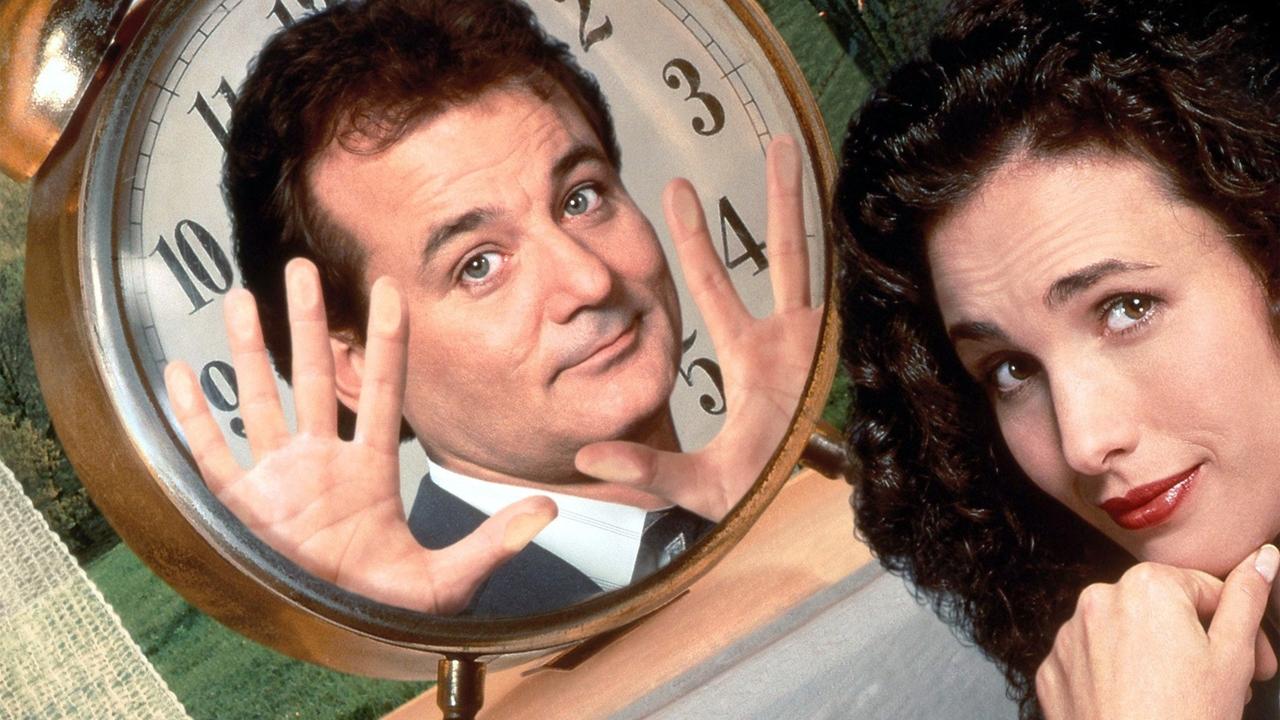
Writer Danny Rubin conceived the idea in 1990 while reading Anne Rice's 'The Vampire Lestat' in a movie theater, musing about what a vampire with limitless time would do, before merging this with an earlier idea about a man reliving the same day.
Rubin picked Groundhog Day almost arbitrarily by opening a calendar and choosing the next nearest holiday, and named the protagonist Phil Connors after the groundhog Punxsutawney Phil.
Rubin's original script had a much darker and more melancholic tone, including a twist ending where Phil breaks the loop but Rita rejects him and becomes trapped in her own time loop instead.
The studio refused to greenlight the film without an explanation for the time loop, so Rubin wrote several possible causes (like a jilted lover's curse or a mad scientist's device), which the filmmakers deliberately scheduled last so they could quietly cut them from the final film.
Tom Hanks was Harold Ramis's first choice for Phil Connors but turned it down, reasoning that audiences would expect his redemption too easily, unlike the unpredictable Bill Murray; Michael Keaton also passed on the role and later regretted it.
Rubin originally wanted Kevin Kline for the lead role, doubting Murray could pull off such a nasty character, but Ramis insisted Murray could be mean and still remain likable to audiences.
Singer Tori Amos was considered for the role of Rita, which eventually went to Andie MacDowell.
Punxsutawney officials, upset the film wasn't shot in their actual town, refused to let the real Punxsutawney Phil groundhog appear on screen, so a groundhog named Scooter, trapped in the wild near Illinois shortly before filming, was used instead.
Although the story is set in Punxsutawney, Pennsylvania, filming took place almost entirely in Woodstock, Illinois, after scouts assessed over 60 towns because Punxsutawney lacked suitable filming locations and amenities.
Bill Murray and director Harold Ramis clashed constantly during the shoot—Murray wanted a more philosophical film while Ramis pushed for comedy—and the two did not speak again until shortly before Ramis's death in 2014, ending their long collaborative partnership that had produced films like Caddyshack and Ghostbusters.
Much of the shoot took place in bitterly cold conditions around 20°F (−7°C), and as filming extended into early summer, the crew used fake snow while actors kept wearing winter gear despite rising temperatures.
During the scene where Phil kidnaps Punxsutawney Phil, the groundhog bit Murray on the knuckle hard enough to break the skin through his glove, and bit him again in the same spot during a later take.
To film Murray stepping into a water-filled pothole, his foot was wrapped in cling wrap, neoprene, and two pairs of socks, and afterward the costume department had to dry his foot with hairdryers to prevent frostbite.
A more elaborate and costly version of Phil's first rebellious morning—where he vandalizes his hotel room and gives himself a Mohawk—took three days to shoot but was ultimately discarded by Ramis in favor of the simpler pencil-breaking scene.
The final scene's costume choice—whether Phil and Rita wake up in the same or different clothes—was decided by a poll of the crew, with a young female crew member casting the tiebreaking vote in favor of the same clothes to avoid ruining the film's tone.
The film's ad-libbed closing line, 'We'll rent to start,' was improvised by Murray in place of the scripted 'Let's live here.'
The term 'Groundhog Day' has since entered the English lexicon to describe a monotonous, repetitive situation, and the film is credited with popularizing time loop narratives and helping mainstream fantasy-comedy films.
In 2006, the film was selected for preservation in the United States National Film Registry by the Library of Congress, and it has been analyzed by Buddhist, Christian, and Jewish scholars as a religious allegory.