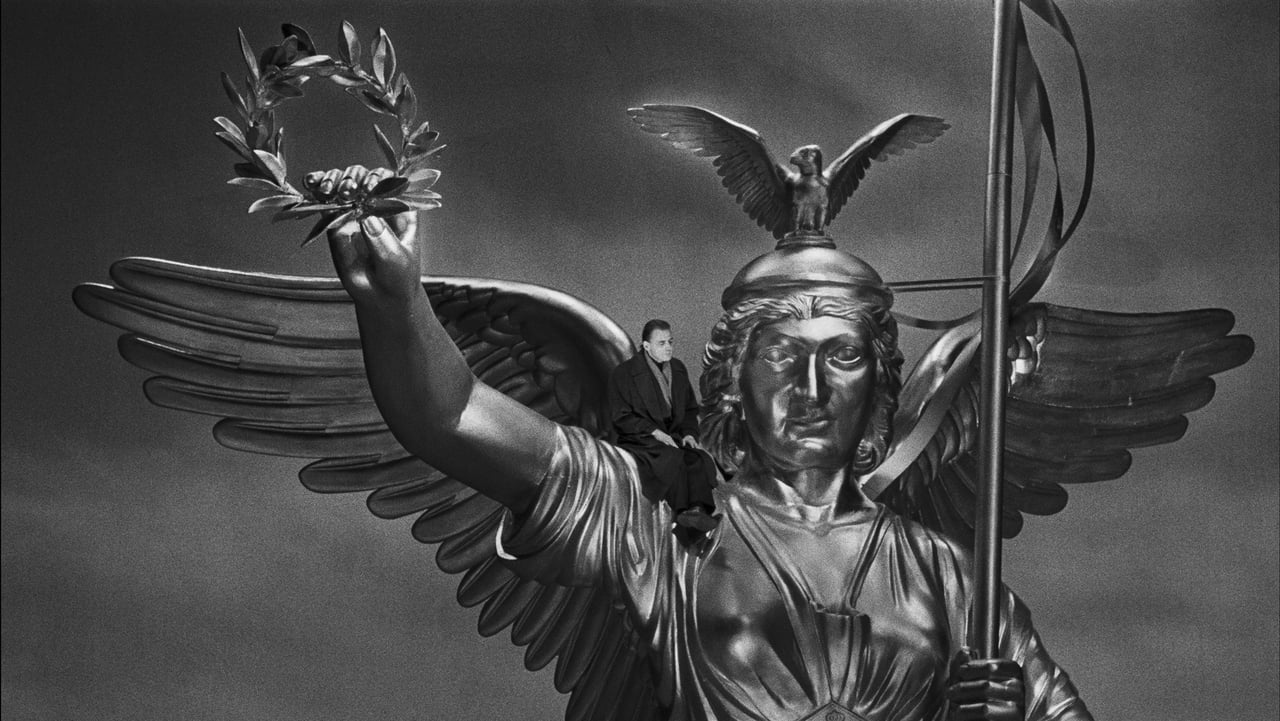
Wim Wenders had planned to make 'Until the End of the World' but realized it wouldn't be ready for two years, so he devised this film as a way to return quickly to shooting and reconnect with his favorite part of Germany, West Berlin.
The story was partly inspired by Rainer Maria Rilke's poetry, in which angels seemed to dwell, as well as by angel-themed artwork Wenders noticed in Berlin cemeteries; an early treatment even considered a backstory where God exiled his angels to Berlin as punishment for defending humans after 1945.
Wenders found the names Damiel and Cassiel in an encyclopedia about angels, and used photographs of Solveig Dommartin, Bruno Ganz and Otto Sander as muses while writing.
Curt Bois' performance as Homer marked the final film role of an 80-year acting career that began when he was a child actor.
Peter Falk's role was not planned before filming began; Wenders originally envisioned an artist or political figure for the part until assistant Claire Denis suggested casting the Columbo star, whom everyone would recognize. Falk called it 'the craziest thing I've ever been offered' but quickly agreed.
During production, the crew called the police after Peter Falk went missing for hours; he was later found simply exploring West Berlin in a café.
Cinematographer Henri Alekan, largely retired at the time, returned to shoot the film as a favor to Wenders; in tribute, the film's fictional circus was named 'Circus Alekan' after him.
To create the muted monochrome look representing the angels' point of view, Alekan used an old, fragile silk stocking that had belonged to his grandmother as a camera filter.
Solveig Dommartin learned trapeze and rope acrobatics in just eight weeks and performed all her circus stunts herself without a stunt double.
For a tracking shot through the Berlin Wall, East German cameraman Thomas Plenert secretly supplied footage from East Berlin, which actor Hanns Zischler smuggled into the West; his involvement was kept secret at the time to avoid getting him in trouble.
The set for the death-strip scene where Damiel announces his decision to become human was specially built, with some pieces made from cheap wood, one of which was destroyed by rain during production.
The angels' costume design, including their armor and hairstyles, was undecided until well into production; the hairstyle was loosely inspired by a photograph of a Japanese warrior, and the filmmakers only settled on overcoats later.
Composer Jürgen Knieper initially thought harps and violins would be enough for the angel scenes, but after seeing a cut of the film he decided the angels seemed discontented and wrote a different score using choir, voices and whistling instead.
Wenders insisted on featuring a concert by Nick Cave, who was based in West Berlin at the time, calling him 'a real Berlin hero' and saying it was inconceivable to make a film in Berlin without showing one of his shows.
A pie fight between the stars was actually filmed for the final scene but was later cut from the finished film.
After Peter Falk left Berlin, he recorded much of his improvised voice-over narration in a sound studio in Los Angeles, with Wenders supervising remotely by telephone.
The closing credits dedicate the film 'to all the former angels, but especially to Yasujiro, François and Andrej', referencing filmmakers Yasujirō Ozu, François Truffaut and Andrei Tarkovsky, all of whom had died before the film's release.
Wim Wenders recalled that in Tokyo the film played to audiences made up almost exclusively of women, a phenomenon no one could quite explain, though one theory was that the male angel characters are notable for listening.
The music video for U2's song 'Stay' incorporated footage from both this film and its sequel 'Faraway, So Close!', with band members portraying invisible angels; Bono has called this his favorite film.
The film was the very first feature film broadcast on the TV channel Arte when it began terrestrial broadcasting on 28 September 1992.