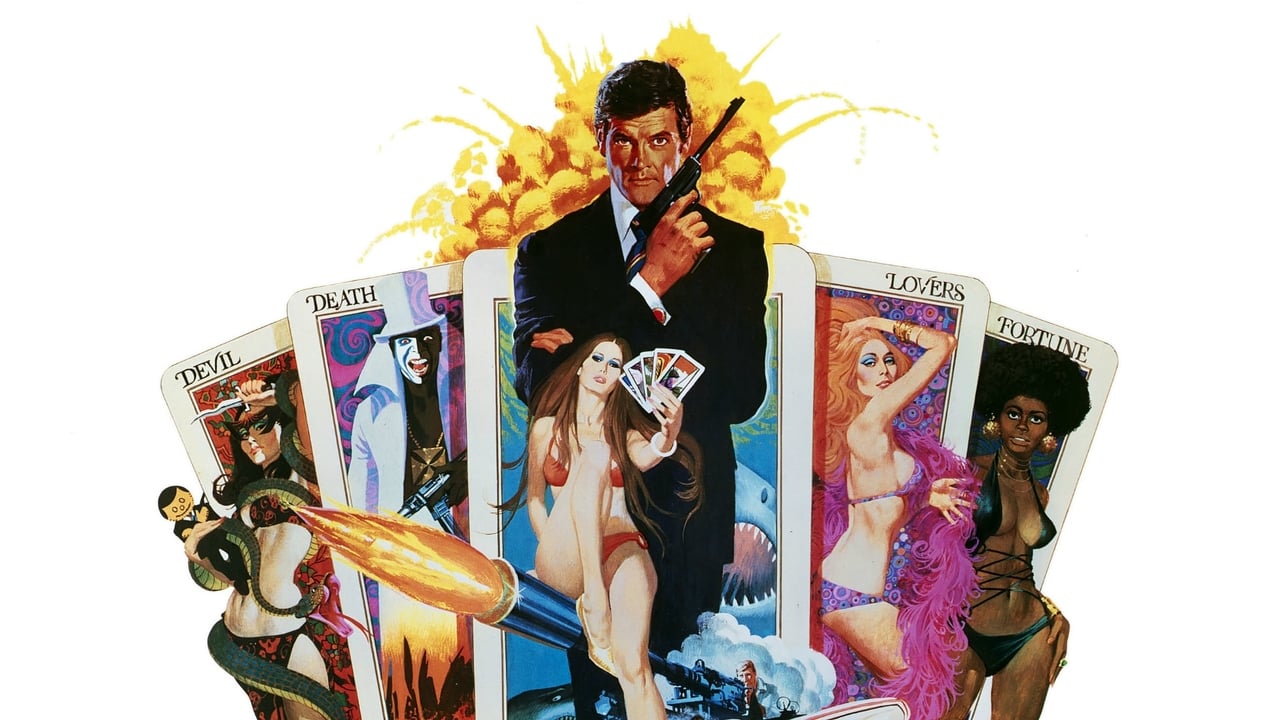

James Bond must investigate a mysterious murder case of a British agent in New Orleans. Soon he finds himself up against a gangster boss named Mr. Big.
Screenwriter Tom Mankiewicz pushed to adapt Live and Let Die because he thought it would be daring to feature black villains at a time when the Black Panthers and other racial movements were active.
Origins
Director Guy Hamilton, a jazz fan, chose to film in New Orleans and used jazz funerals and the city's canals instead of Mardi Gras, since a similar festivity (Junkanoo) had already appeared in Thunderball.
Origins
The filmmakers scouted Haiti to study real Voodoo practices for authenticity, but political unrest under the Duvalier regime forced them to shoot in Jamaica instead.
Origins
While location scouting in Jamaica, the crew found a crocodile farm in Falmouth owned by a man named Ross Kananga, whose name inspired that of the film's villain, Dr. Kananga.
Origins
Veteran Bond writer Richard Maibaum turned down the chance to write the script, later saying he disliked the finished film because processing drugs in the jungle was 'not a Bond caper'.
Casting
Before Roger Moore was cast, the producers considered numerous actors for Bond including Julian Glover, John Gavin, Jeremy Brett, Michael Billington (the frontrunner), Anthony Hopkins, and Dick Van Dyke, while United Artists pushed for Americans like Steve McQueen and Paul Newman.
Casting
Burt Reynolds claimed he was offered the role of Bond but turned it down, feeling the character should be played by a British actor.
Casting
Screenwriter Tom Mankiewicz initially wanted to make Solitaire a Black character and considered Diana Ross, but producers stuck with Fleming's description of a white woman and cast Jane Seymour after considering Catherine Deneuve; the character of Rosie Carver was then changed to a Black woman, played by Gloria Hendry.
Casting
Live and Let Die is the only Bond film between Dr. No and Casino Royale (2006) to not feature Q, as producers decided to downplay the gadget aspect of the series, much to actor Desmond Llewelyn's annoyance.
Filming
Production nearly lost Bernard Lee as M after the death of his wife, and Kenneth More was considered as a replacement, but Lee ultimately returned to the role.
Filming
Lois Maxwell returned as Moneypenny for the same fee as before, but a filming error extended her scenes to two days, ultimately costing the production more money than if they had granted her requested pay raise.
Filming
Filming began in October 1972 in New Orleans, but was delayed when Roger Moore was diagnosed with kidney stones, forcing only the second unit to shoot for a time.
Filming
The producers reportedly had to pay protection money to a local Harlem gang to film safely, and when the funds ran out they were forced to leave, shooting some exteriors on Manhattan's Upper East Side instead.
Filming
Ross Kananga, the crocodile farm owner who inspired the villain's name, personally performed the stunt of Bond jumping across crocodiles' backs, which took five attempts and once resulted in a crocodile biting his heel and tearing his trousers.
Filming
During the voodoo ceremony scene in Jamaica, snakes caused several incidents: an actor fainted after being bitten, Jane Seymour became terrified, and a snake nearly reached her before being grabbed by the film's snake handler just inches from her feet.
Filming
For the boat chase, the Glastron company built 26 boats for the production, of which 17 were destroyed during rehearsals alone.
Filming
The speedboat jump over the bayou unintentionally set a Guinness World Record at the time, clearing 110 feet, with the resulting wave causing the following boat to flip over.
Filming
The double-decker bus stunt used a modified former London bus with its top deck remounted on rollers so it would slide off upon hitting a low bridge, and was performed by London Transport driving instructor Maurice Patchett.
Effects
Salvador Dalí was approached in 1973 to design a Surrealist tarot deck for the film but his fee was too costly for the budget; the deck actually used was designed by Fergus Hall, while Dalí released his own version in 1984.
Music
Composer John Barry, who scored the previous seven Bond films, was unavailable due to work on the stage musical Billy, leading producers to hire Paul McCartney to write the theme song and George Martin, the Beatles' producer, to score the film.
Music
Most of the film's $25,000 music budget went to Paul McCartney's fee for the theme song, leaving too little to hire a composer of John Barry's stature.
Music
Producers hired singer B.J. Arnau to record and perform the title song for a nightclub scene, not realizing that Paul McCartney and Wings intended to perform it themselves for the main theme.
Reception
The film holds the record for the most-watched broadcast film on UK television, attracting 23.5 million viewers when it premiered on ITV on 20 January 1980.
Memorable quotes
/
[after finding a feathered hat in the cabin, Rosie Carver looks fearful, but Bond tries to console her] Don't worry darling, it's just a hat, belonging to a small-headed man of limited means, who lost a fight with a chicken.
James Bondconsoling Rosie Carver after she finds a feathered hat in the cabin
I should have told you. Never go in there without a mongoose.
James Bondwarning about the dangers lurking in a mysterious place