
No connection

King Kong Escapes

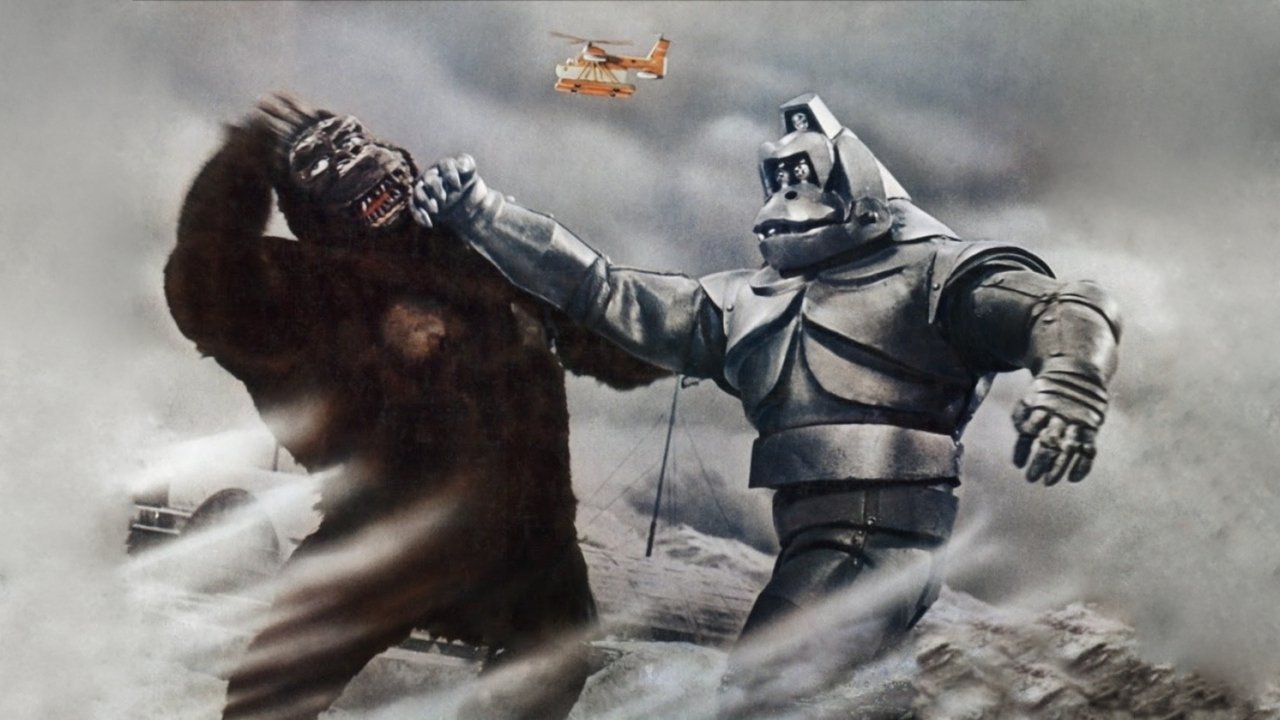
The electronic monster Mechani-Kong boldly challenges the ruler of the South Seas, King Kong!!

1967 · 104 min · Action
6.2 Niche
Action Fantasy Horror Science Fiction

An adaptation of the Rankin/Bass cartoon, "The King Kong Show". King Kong is brought in by the evil Dr. Who to dig for Element X in a mine when the robot Mechani-Kong is unable to do the task. This leads to the machine and the real Kong engaging in a tremendous battle atop Tokyo Tower.

Original title
キングコングの逆襲
Country of origin
🇯🇵 Japan
Year
1967

Trivia & behind the scenes

/
Origins

The film was produced as a commemorative work for Toho's 35th anniversary, made in partnership with Rankin/Bass Productions, since Toho's license to use King Kong (obtained for King Kong vs. Godzilla) was only valid for five years and set to expire soon.

Origins

An earlier project titled 'Operation Robinson Crusoe: King Kong vs. Ebirah' was planned the previous year but negotiations fell through, leading to a new version incorporating Dr. Who and Mechani-Kong to align with the concurrent Rankin/Bass animated TV series, The King Kong Show.

Origins

Arthur Rankin Jr., head of Videocraft International which produced the King Kong animated TV series, served as technical advisor on the film.

Casting

Linda Miller, who played Susan Watson, had no acting experience and was working as a model when producer Arthur Rankin Jr. spotted her in a gravure photoshoot in the magazine Josei Seven and cast her.

Casting

Mie Hama was cast as Madame Piranha as a last-minute replacement after original choice Akiko Wakabayashi did not renew her Toho contract and went freelance.

Casting

Because Linda Miller was not a member of the Screen Actors Guild, her voice was redubbed by Julie Bennett for the English version, while Rhodes Reason (who was a SAG member) was able to re-dub his own character; Miller was reportedly upset she wasn't invited to redub her own lines.

Filming

The character of Gorosaurus was designed as a deliberate homage to the Tyrannosaurus fight from the original 1933 King Kong, even sharing its three-toed forefeet, leading the filmmakers to classify Gorosaurus in-universe as a species of Allosaurus.

Effects

Because the film's monsters were designed at a smaller scale (20 meters) than Godzilla (50 meters), the miniatures were built at a larger 1/15 scale instead of the usual 1/25 scale used in Godzilla films, resulting in more detailed models.

Effects

The Tokyo Tower miniature set was specially engineered with welded steel framing instead of the usual wood-and-nails construction, since the design required two suited monsters to climb and fight on it without collapsing.

Effects

The film used a unique five-strip compositing process combining standard footage, a mask film, and three RGB monotone films to eliminate the flickering edges typical of bluescreen compositing; effects artist Koichi Kawakita considered the results excellent but the process was never used again due to its inefficiency.

Effects

This was the first Toho film to use a radio-controlled, self-propelled Type 61 tank miniature with an internal engine capable of turning, whereas earlier tank miniatures could only move in straight lines pulled by piano wire.

References

Mechani-Kong's roar sound effect was later reused for the capsule monster Windam in the Ultra Series show Ultraseven.

References

The stock footage of Gorosaurus living on Monster Island in the 1969 film All Monsters Attack was reused footage taken directly from King Kong Escapes.

References

Producer Tanaka Tomoyuki's idea for Mechagodzilla in Godzilla vs. Mechagodzilla reportedly originated from him recalling Mechani-Kong and wondering if a similar robot could be built for Godzilla.

Trivia

Toho originally considered including King Kong in an early draft of Destroy All Monsters (1968) but dropped him because the studio's rights to the character were expiring.

Trivia

In the early 1990s, Toho considered a project called Godzilla vs. Mechani-Kong, reviving Mechani-Kong as Godzilla's opponent after a planned Godzilla vs. King Kong remake fell through, but the project was cancelled when it became clear that even using King Kong's likeness would require difficult rights negotiations.

Reception

Despite being praised for its high level of special effects craftsmanship, the film was not a box office success in Japan, and younger audiences reportedly preferred its co-feature, the Ultraman feature film, at the time.

What people are saying (0)

Log in to share your take.

No reviews yet.

Nothing yet. Start the conversation!

New version available

A Seenr update was just released. Reload to get it.