Director Florian Henckel von Donnersmarck first conceived the idea for the film while studying feature film directing at the Munich Film School starting in 1997, then spent nearly four years from 2001 researching the project, interviewing both Stasi victims and perpetrators and visiting historical locations.
To write the first draft of the screenplay, Donnersmarck spent a month living in a cell at Heiligenkreuz Abbey in the Wienerwald, whose abbot was his uncle Gregor, before moving from Munich to Berlin to finish the script.
The film was made on a very low budget of about 1.8 million euros, which was only possible because actors and crew worked for a fraction of their usual fees; actor Sebastian Koch said everyone worked 'for less than half the usual fee, out of conviction that they were making an important film.'
Actor Ulrich Mühe had received many scripts about East Germany before but found none interesting because they were 'always too short, always falling too short,' until Donnersmarck's script impressed him with its accuracy and empathy for the era.
Donnersmarck wanted Lebanese composer Gabriel Yared, who usually worked on much bigger-budget productions, so he translated the entire screenplay into French so Yared could get a sense of the film; Yared agreed and was assisted by Stéphane Moucha, who orchestrated the score and occasionally co-composed.
Filming took place over just 37 days between October 26 and December 17, 2004, leaving no room for improvisation; the director ran a demanding but polite set with long working days and short breaks.
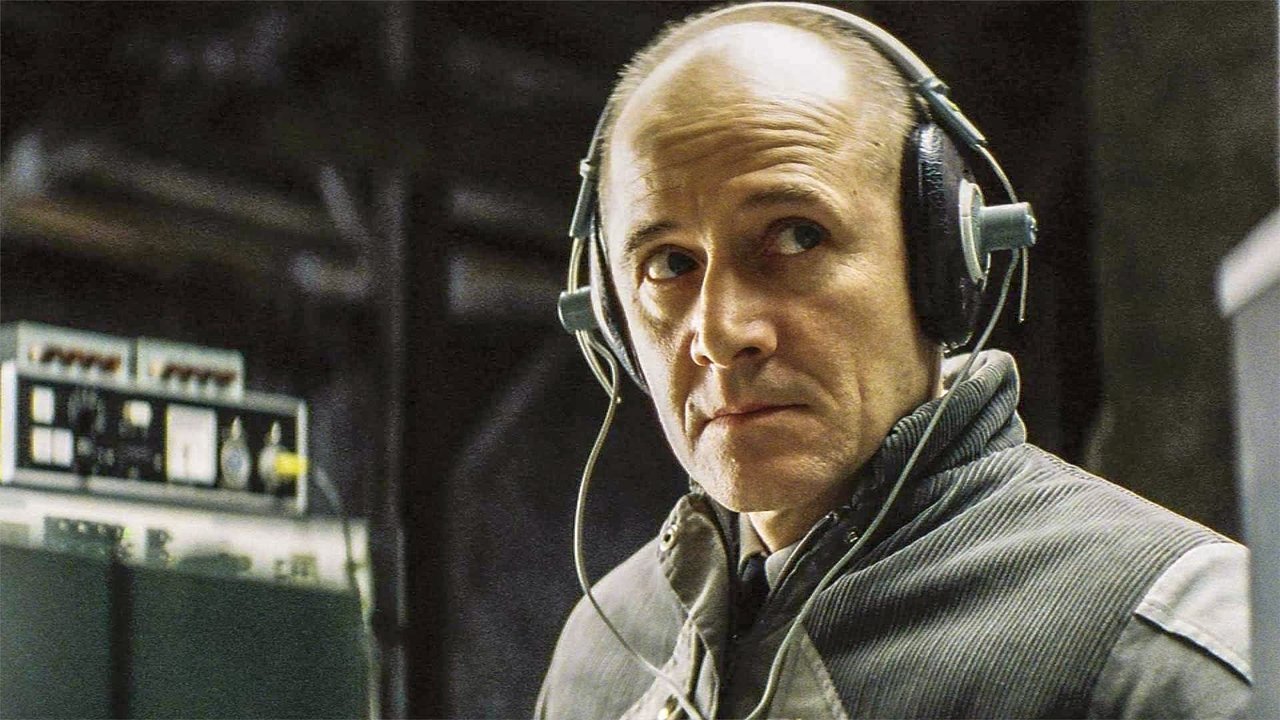
For historical authenticity, the surveillance equipment shown in the film consisted of original Stasi recording devices, and the sound was recorded on an old analog Nagra machine at the director's insistence, with the sound engineer converting it to digital format each evening; the film was shot on 35mm to achieve a cinematic look despite the low budget.
Most filming took place in Berlin, including at the former Stasi headquarters on Normannenstraße, where a room next to Erich Mielke's former office served as Grubitz's office in the film; a 72-hour parking ban was imposed on Wedekindstraße for exterior shots of Dreyman's building.
The director of the Berlin-Hohenschönhausen memorial, Hubertus Knabe, refused to grant filming permission at the former Stasi remand prison, reportedly because he felt the screenplay glorified the Stasi; the memorial's rules only allowed permits for documentaries, not fiction.
Cinematographer Hagen Bogdanski deliberately avoided cranes or steadicams due to the low budget, using mostly close-ups and almost no wide shots, partly to avoid historically inaccurate elements entering the frame; the director developed a strict color palette after studying East German photo books, replacing red with orange and blue with green, achieved entirely through set design and costumes without camera filters.
The film's producers submitted it as a competition entry for the 2006 Berlinale, but festival organizers rejected it, a decision later criticized in the international press.
The film won numerous awards including seven German Film Awards (from eleven nominations), the Bavarian Film Award in four categories, the European Film Award in three categories, and the Academy Award for Best Foreign Language Film.
A legal dispute arose after Ulrich Mühe stated in the accompanying film book that his ex-wife, actress Jenny Gröllmann, had spied on theater colleagues for the Stasi; a Berlin court ruled the claims could not be presented as fact, and after Gröllmann's death in August 2006, Mühe signed a cease-and-desist declaration in January 2007.
In the DVD audio commentary, Donnersmarck mentioned that the Stasi records authority had confirmed politician Gregor Gysi's activity as an unofficial collaborator, but a court barred calling him 'IM Notar'; after Gysi's legal demand, distributor Buena Vista halted delivery of that DVD version in January 2007 and released an edited version with the sensitive commentary passages removed.
Writer Christoph Hein said Donnersmarck had asked him in 2002 to describe the typical life of a typical GDR playwright, and his name appeared in the premiere credits, but Hein later asked for his name to be removed, calling the film a 'horror fairy tale' set in a legendary land rather than an accurate depiction of 1980s East Germany.