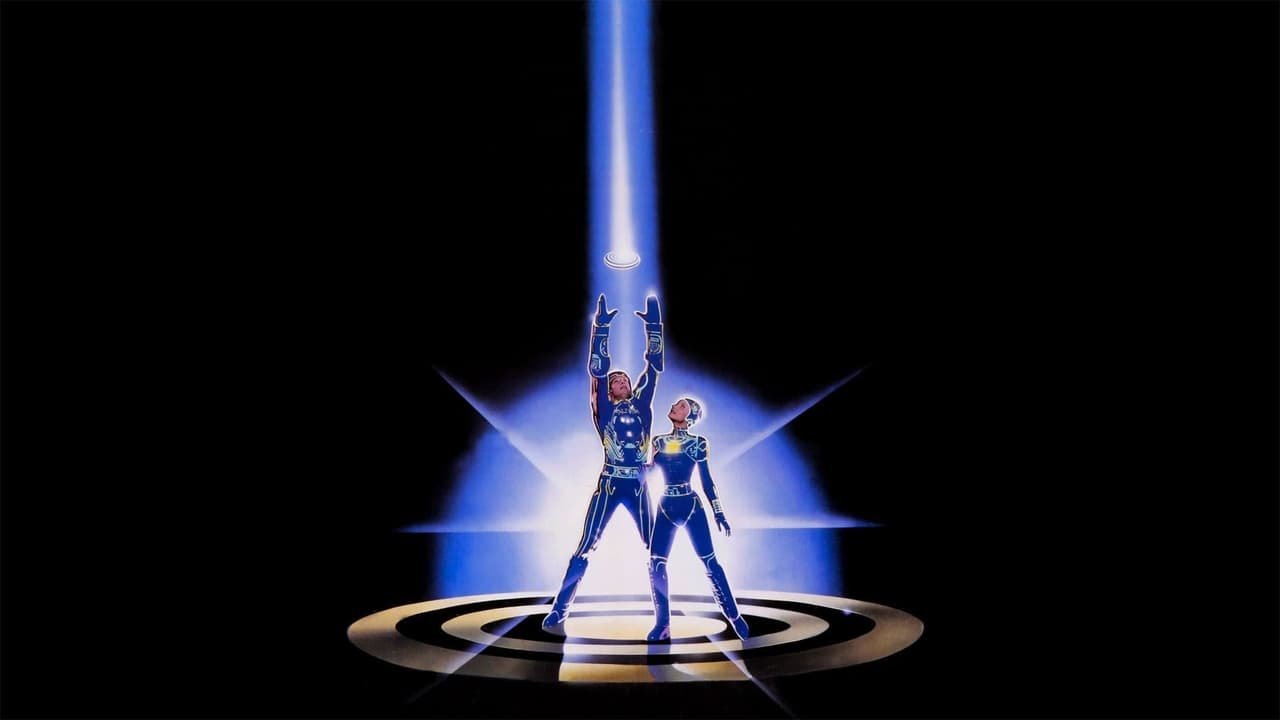
The inspiration for Tron dates back to 1976, when Steven Lisberger became fascinated by video games after seeing a computer graphics reel from firm MAGI and playing Pong for the first time; the parallel game-world concept was also inspired by Alice in Wonderland.
Lisberger first created Tron as a glowing yellow, bearded character resembling the Cylon Centurions from Battlestar Galactica for a 30-second promotional animation, before the color scheme was changed to blue for heroes.
After Variety mentioned the project, computer scientist Alan Kay contacted Lisberger, became an adviser, and convinced him to use computer-generated imagery instead of pure hand-drawn animation.
The storyboards and animation samples were rejected by Warner Bros., MGM, and Columbia before Walt Disney Productions finally agreed to finance and distribute the film in 1980, partly to compete with Star Wars.
Screenwriter Bonnie MacBird based the character of Alan Bradley on Alan Kay, with whom she later fell in love and married; she originally envisioned Kevin Flynn as a more comedic character and suggested Robin Williams for the role.
None of Bonnie MacBird's original dialogue survived Disney's rewrites, which shifted the tone toward something more serious with quasi-religious themes, leading to what she called a 'bitter credits dispute'.
Because Disney's animation department was reluctant to collaborate with outside filmmakers, the production team hired Wang Film Productions and Taiwan's Cuckoo's Nest Studio for animation work, and the Taiwanese crew members were unusually credited using Chinese characters in the end credits.
Only about 15 to 20 minutes of the film used actual computer-generated animation; computers of the era, some with just 2 MB of memory, could not render motion, so each frame had to be produced individually and photographed off a screen with a motion picture camera.
Most of the 'electronic world' visuals were created via a laborious 'backlit animation' process using black-and-white Kodalith high-contrast film sheets, sometimes requiring up to 50 camera passes per shot; this technique was never repeated for another feature film due to its cost and difficulty.
A Kodak manufacturing quirk with numbered Kodalith sheet batches caused the glowing circuit lines to flicker unintentionally between shots; once discovered, the crew used sheets in batch order and added 'zinger' sound effects to make the flickering appear intentional as a computer malfunction, later digitally corrected for the 2011 Blu-ray.
The color scheme originally called for good programs to be yellow and evil ones blue, but was changed partway through production to blue for good and red for evil, leaving inconsistencies like Clu's yellow circuit lines and mismatched light-cycle and tank colors.
Several scenes were filmed inside the real Lawrence Livermore National Laboratory, including its multi-story laser bay used as ENCOM's laser bay and a stairway in Building 451; at the time, Tron was the only film ever granted permission to shoot inside the lab.
The score was composed by electronic music pioneer Wendy Carlos, mixing Moog and Crumar GDS synthesizers with orchestral recordings by the London Philharmonic, which Disney insisted on hiring in case Carlos could not finish the score in time.
Two tracks, '1990's Theme' and 'Only Solutions', were contributed by the band Journey after British band Supertramp dropped out of the soundtrack project.
The filmmakers hid several Easter eggs, including a Pac-Man appearing (with matching arcade sounds) behind Sark during the Light Cycle escape scene and a 'Hidden Mickey' outline visible beneath the solar sailer.
The Academy of Motion Picture Arts and Sciences refused to nominate Tron for a Best Visual Effects Oscar because, according to Lisberger, 'The Academy thought we cheated by using computers'; it still received nominations for Best Costume Design and Best Sound.
John Lasseter, head of Pixar, later said 'without Tron, there would be no Toy Story,' citing the film's influence on his understanding of CGI's potential for animated features.
Because ENCOM employees' personal data existed inside the Grid, the filmmakers decided each real-world character should have a digital counterpart, which is why the same actors played dual roles in both the real world and the computer world.