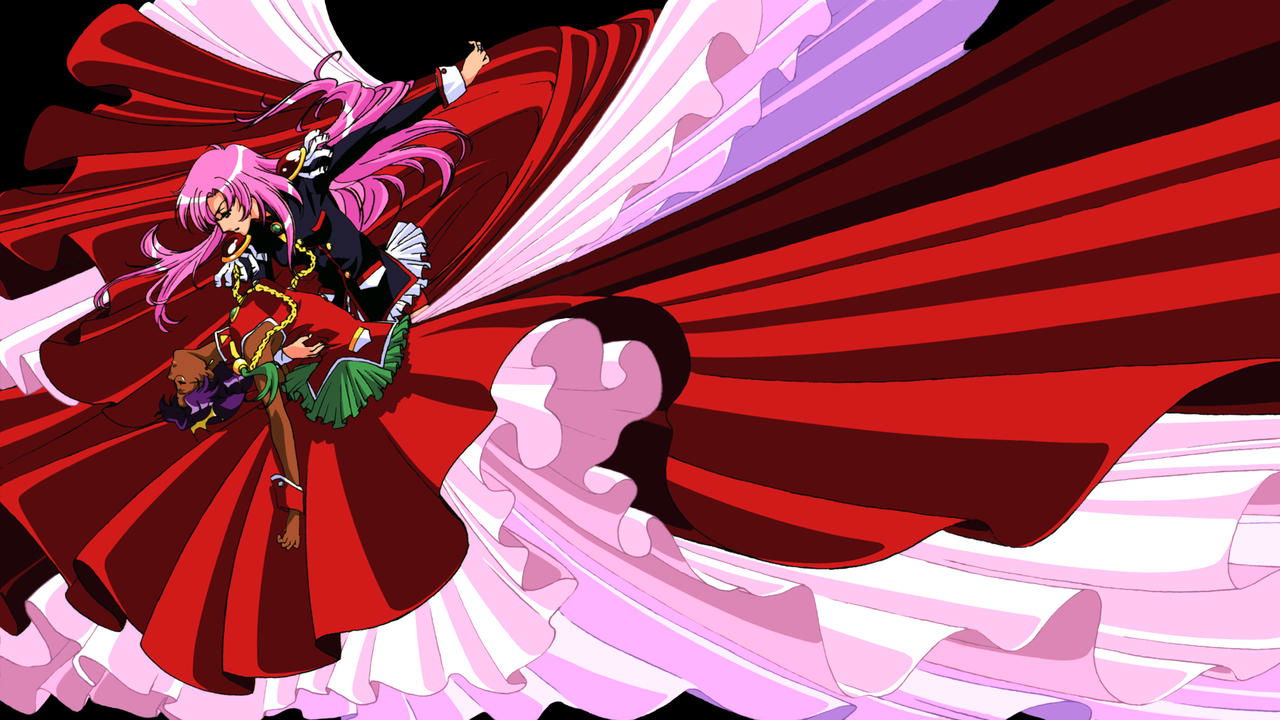
Director Kunihiko Ikuhara, previously a director on the Sailor Moon anime adaptation at Toei Animation, left the studio in 1996 after growing frustrated by the lack of creative control on an adapted work, forming the production group Be-Papas to create an original series.
Be-Papas means 'let's become adults' and was intended to give anime production staff, who were rarely credited as original creators, the standing of authors.
The earliest pitch for the series was titled 'Revolutionary Girl Utena Kiss' and featured a heroine who transformed into a boyish beauty by kissing someone, aimed at a toy-company sponsor for a children's show.
Ikuhara originally conceived Utena as a mainstream shōjo series to capitalize on the commercial success of Sailor Moon, but the direction shifted dramatically during production toward an avant-garde, surrealist, non-commercial tone.
Manga artist Chiho Saito, who had never worked in anime before, was recruited to Be-Papas after Ikuhara saw an illustration from her manga series Magnolia Waltz on a magazine cover, and she was specifically brought in to prevent the all-male team from creating an unintentional parody of shōjo manga.
Ikuhara wanted Utena and Anthy to become romantically intimate, but Saito, drawing on her experience as a shōjo manga creator, strongly opposed this as something the young female audience would not want; the resulting shock reportedly gave Ikuhara acute gastroenteritis.
Ikuhara and Saito clashed so severely over how to depict Utena and Anthy's relationship that they did not speak to each other for three months during production, with Ikuhara concealing from Saito how far he intended to push the romantic framing of their bond.
The series drew inspiration from the Takarazuka Revue, the artwork of Jun'ichi Nakahara, Hermann Hesse's novel Demian, and the experimental theater of Shūji Terayama; Ikuhara acknowledged its resemblance to Princess Knight and The Rose of Versailles but feared Utena would be dismissed as mere parody of those works.
Composer J. A. Seazer, a former collaborator of avant-garde theater director Shūji Terayama, provided the series' experimental choral songs despite the show's financiers being strongly opposed to his avant-garde style; Seazer agreed to join partly because he was a fan of Sailor Moon.
When commissioning the opening theme 'Rondo-Revolution', Ikuhara told singer-composer Masami Okui to write it as if it would play during the story's final scene, even though at the time he had not yet decided what that ending would actually be, giving her only vague key phrases like 'lose everything' and 'change the world'.
Voice actress Tomoko Kawakami was cast as Utena partly because she did not read the character description before her audition and so spoke naturally instead of putting on an exaggeratedly masculine voice like other candidates; this role went against her prior typecasting in boisterous gyaru-type characters.
Conceptual designer Hiroshi Nagahama, who designed the dueling arena and Ohtori Academy's buildings, compared his design process to creating a theatrical stage set, focusing only on what would be visible to the audience, using free compositions that ignored gravity and structural logic.
Art director Shichirō Kobayashi, a veteran in his 60s at the time of broadcast, said Ikuhara's image-driven direction shocked him, such as instructing artists to leave a blank white sky behind an archway instead of drawing an expected building, a creative leap Kobayashi compared to working with director Osamu Dezaki.
Episode 27, 'Nanami's Egg', shows a marked influence from Mamoru Oshii's film Angel's Egg, with phrases reminiscent of it appearing in the episode.
Voice actress Tomoko Kawakami, who played Utena, died of ovarian cancer in June 2011; North American distributor Right Stuf dedicated its DVD release of the Apocalypse Saga to her memory.
For its North American release, a localization proof-of-concept was produced under the title 'Ursula's Kiss' giving the characters English names for potential Western distributors, though this version was never used and the series was ultimately released under its original title by Central Park Media.
The manga adaptation by Chiho Saito, serialized before the anime went into production, diverged significantly in plot from the anime because Saito had to guess how to depict story elements based on Yōji Enokido's scripts and Ikuhara's vague answers, leading her to change editors five times during its year-and-a-half serialization.