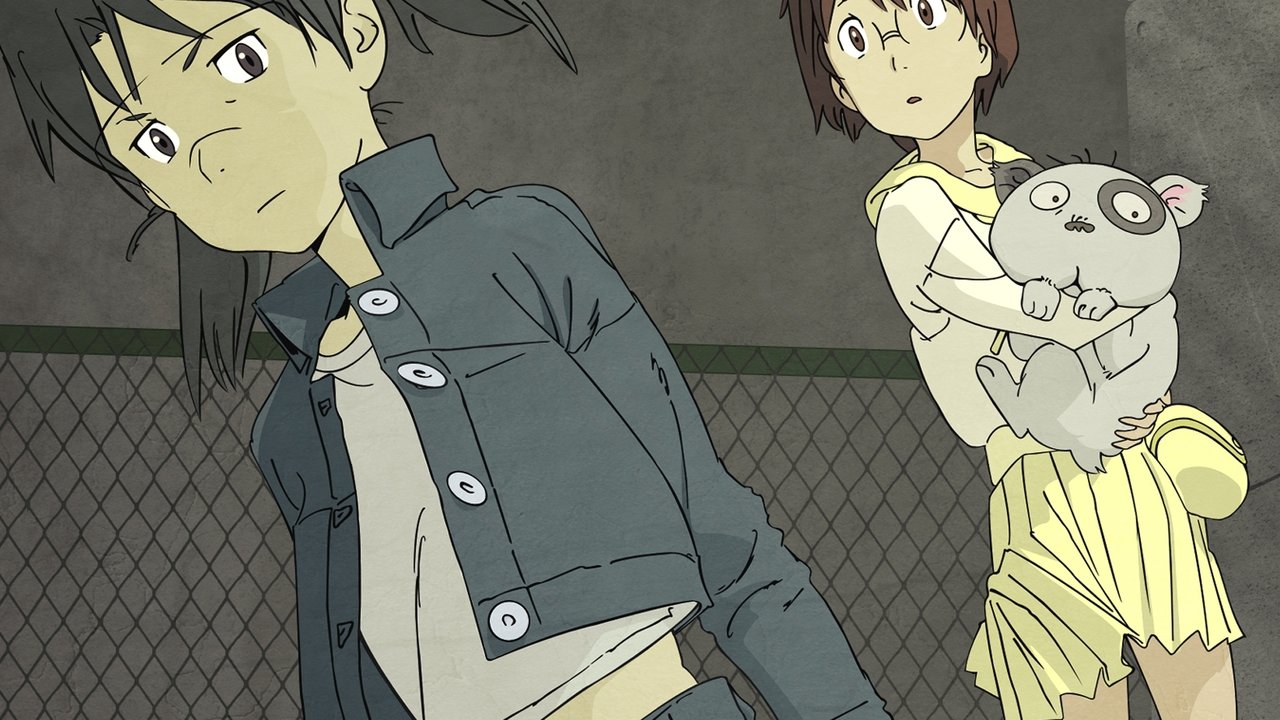
Director Mitsuo Iso began imagining the concept of Den-noh Coil in 1999, starting from an image he had in his head since childhood: 'when you put on glasses, you see a parallel world'. The project document was ready around April 2000.
Iso took the project to various production companies and animation studios for years without success, until in 2002 producer Sanae Mitsuki, from Tokuma Shoten, fell in love with the idea after seeing it presented by Studio Ghibli animator Katsuya Kondo, and decided to pursue the project as the publisher's first TV animation.
It was thanks to the help of Masao Maruyama, then president of Madhouse and known for giving opportunities to talented directors, that the project secured a studio to be produced; the team worked in an annex room, not relying on Madhouse's main team.
From the first sketch to the completion of the series, about seven years passed, and throughout development the story went through about 30 different variations before the final plot was locked in, about a year before the premiere.
The original idea was not about augmented reality, but about children who gained magical powers through technological items; the title creature 'Coil' would be a digital pet that lived with the protagonist, but Iso couldn't develop dialogue or a relationship for the character, which ended up being abandoned early in development.
The character Michiko went through major changes: originally she would be a transfer student of flesh and blood named 'Michiko', and she was the one who would have the central role that later fell to Isako; over time the roles of the two merged until only the character Isako remained.
Yasako's personality also changed quite a bit: originally she would be decisive, full of initiative and good at hacking, but to create contrast with Isako, Iso swapped her personality and role with those of the character Fumie, who was previously the quiet follower; this change unblocked the script and Iso wrote it all at once, in less than two months, up to episode 12.
The ending of the series reuses a conclusion idea that Iso had proposed for Neon Genesis Evangelion, but which was not accepted at the time.
The work was influenced by the children's literature of Taijiro Amazawa (such as the series 'Hikarigurumayo, Maware!' and 'Orange Party') and the novel 'No Life King' by Seiko Ito, the latter being cited by Iso as a pioneer in emotionally depicting something important existing within games and computers.
Iso chose to portray augmented reality (AR) and mixed reality (MR) instead of virtual reality (VR) because VR had already become popular after the success of the film The Matrix, and he felt it would not make sense to revisit the theme; furthermore, as these were technologies little known at the time, he thought script errors would draw less attention from the public.
Despite the animation looking very fluid, Iso himself revealed that the number of drawings per episode was about 3,000 to 6,000 (for example, about 3,500 in episode 12), much less than other series of the time, which used up to 20,000 drawings per episode.
Most of the characters had their initial design sketched by Mitsuo Iso himself, and then finalized by character designer Yu Honda.
John Hanke, who at the time headed Google's geolocation department and later founded Niantic, was a self-declared fan of Den-noh Coil, according to revealed by members of Niantic itself.
In December 2009, the series was used as the theme for a pioneering augmented reality promotion in Japan, carried out by Tokyu Corporation in partnership with NEC and the National Institute of Informatics, as part of a project by the Ministry of Economy, Trade and Industry.
Before the production of the series began, Iso was invited to draw an original manga for Animage magazine, but gave up after only three pages.