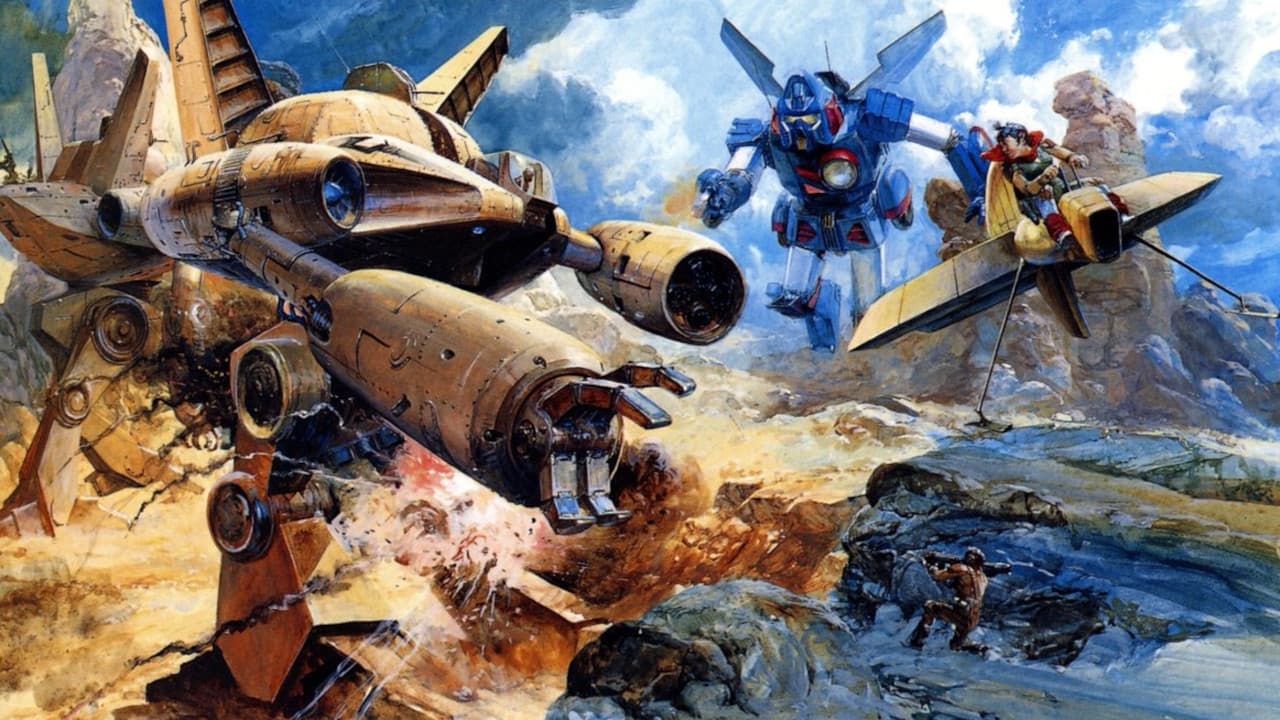
Yoshiyuki Tomino (then still credited as Yoshiyuki Tomino after changing his name from Yoshiyuki Tomino/Tomino Yoshiyuki reading) returned to TV anime directing for the first time in two years since Space Runaway Ideon, in the same Saturday timeslot that had previously aired his breakthrough hit Mobile Suit Gundam.
The project was originally developed under the working title 'Exploiter' as a serious space-based robot anime led by writer Yoshitake Suzuki and director Soji Yoshikawa, complete with preparatory design art, before Yoshikawa stepped down due to being too busy and Tomino was brought in as replacement director.
Tomino overhauled almost the entire concept overnight, shifting the setting from a serious space story to a Western-style world where giant Walker Machines are powered by gasoline engines and controlled with car-like steering wheels and gas pedals, referencing the real-world oil crisis of the era as inspiration for the gasoline-powered mecha.
Tomino has said he began exploring the show's directing style by imitating Future Boy Conan and told his staff to also emulate The Castle of Cagliostro, reflecting his admiration for Hayao Miyazaki's work, according to designer Yutaka Izubuchi.
Because Tomino had earned the nickname 'Kill 'em all Tomino' from earlier tragic works, Xabungle was deliberately produced under the concept that 'no one dies,' a policy later carried over to his next series, Galactic Drifter Vifam.
The constant rewriting of scripts and storyboards by Tomino, including altering dialogue into his signature conversational 'Tomino style,' caused deep friction with original writer Yoshitake Suzuki, and the two never worked together again after this production.
Character designer Tomonori Kogawa was unable to work on episodes 2 through 26 due to scheduling problems after the overloaded episode 1, meaning the drawing approach set during that unsupervised stretch simply carried through for the rest of the series once he returned from episode 27 onward.
Animation director Sasakado Nobuyoshi noted that despite the hero's simple round-faced design seeming easy to draw, he actually mismatched the character's eye height in episodes 1 and 2 due to the design's deceptive simplicity.
Photography director Akio Saito described the production as unusually demanding, citing frequent 'inbetween omission' shortcuts and the difficulty of reusing the same opening and ending footage cleanly multiple times.
Sound designer/animation staff noted the show used irregular 1-to-3 frame shooting intervals instead of the industry-standard 3-frame shooting, giving the series an unusually fast sense of timing that animators struggled to match consistently.
The two Xabungle units were originally intended by toy sponsor Clover to combine into a single combined robot, with a combined-Xabungle toy planned for the show's second half, but this was replaced by the new Walker Gallier mecha instead.
The Walker Gallier toy sold poorly, partly because Tomino personally insisted on design changes for it, leading Bandai's sponsor newsletter to be flooded with complaints and its 1/100 scale plastic model kit being cancelled due to declining overall toy sales for the series.
Tomino himself rated the series harshly, saying 'if I had to give it a score, 30 points would be generous... the story falls apart, it's a complete failure by conceptual standards, honestly full of flaws,' yet he simultaneously called it a successful experiment and claimed 'anime's true path should be like Xabungle.'
Tomino has admitted that during production he became harshly confrontational with the animation staff, at one point declaring things like 'what you remember about how to make anime is all a lie' and 'listen to me, the general director,' behavior he acknowledges was akin to workplace harassment, causing several animators and directors to quit or flee the production before the studio's mood eventually turned around by the third quarter of the show.
Episode 27, 'Sing! The Warriors' Song,' was never broadcast in the Kansai region during the original 1982 run because Asahi Broadcasting Corporation extended its coverage of the national high school baseball tournament, and no makeup broadcast was ever aired for it, an unprecedented gap not repeated by any other episode of the show; the episode finally had its first Kansai broadcast 35 years later, on Sun Television in October 2017.
The compilation film Xabungle Graffiti, released in 1983, was built around a 90-minute runtime constraint since it was originally paired as a double feature, so instead of being a straightforward digest it became a comedic clip-show framed as flashbacks with in-jokes; one sequence even displayed captions joking about using raw uncolored animation cels because the production ran out of time.
In Xabungle Graffiti, Tomino changed the ending to bring back the previously deceased Arthur Rank, who offers to treat the blinded Elchi, because Tomino felt the TV series' original bittersweet ending of Arthur's death and Elchi's blindness clashed with the franchise's declared 'no one dies' concept.
Much of the show's score reuses music that composer Koji Makaino had originally written for the anime The Rose of Versailles.