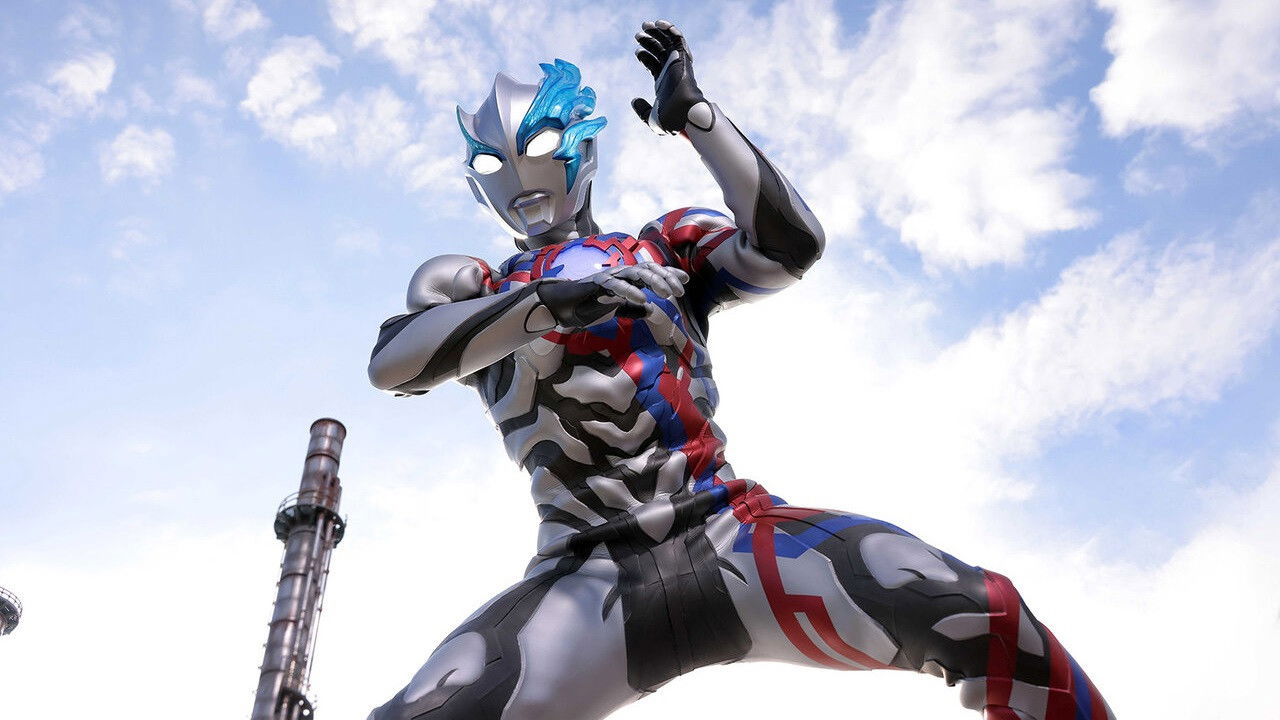
Series chief director Takaguchi was given full creative freedom to build the show from scratch, taking over from the New Generation era started with Ultraman Dyna and meant as a replacement for Ultraman Gaia's slot, rather than a continuation of the recent 'New Generation' series.
Writer Keigo Koyanagi, who had been away from Ultraman for a while, was told by Takaguchi not to rewatch recent entries but to freely develop ideas from the theme, so he wrote without being bound by past continuity.
The production deliberately avoided staples of the recent 'New Generation' series—type changes using past Ultramen's powers, reused past kaiju, item-collecting plots, inner space, transformation catchphrases, and typical villains—to make the show feel distinct.
Because the show was planned from the start for simultaneous worldwide release with an English dub, legacy elements referencing past Ultraman series were minimized so new international viewers could enjoy it without prior knowledge.
Since Ultraman Blazar does not use type changes, producer discussions about Bandai's toy strategy led to the decision to introduce many new kaiju instead, with Takaguchi proposing that new monsters appear in half of the total episodes (12).
Because Blazar aired concurrently with Ultraman Decker, both shows needed to draw from the same pool of well-preserved kaiju suits, leaving few usable existing monsters and pushing the staff to create even more new kaiju designs.
This is the first Ultraman series to feature a team captain in his 30s as the main protagonist among monster-fighting teams, a choice made because a captain's position—caught between the front line and the upper command—was considered the most dramatically interesting perspective.
During auditions, actress Yoshimi Naito emphasized her skills in martial arts and muscle training without mentioning karate; after she was cast and later mentioned she practiced karate, her character Anri's introductory training scene was changed from a bench press in a gym to a karate dojo during costume fitting.
Yasunobu's Kansai dialect wasn't originally planned; during a script read-through for episode 3, actor Kajiwara struggled with a technical line about the robot Earthgaron, so director Takaguchi had him explain it in his own words, causing his natural Kansai accent to slip out, which led to the character being rewritten to speak Kansai dialect permanently.
Auditions for this series were unusually short and informal, more like interviews than full-scale casting calls, due to a shorter than usual preparation period.
Since Ultraman Blazer doesn't speak any language, suit actor Eiyu Iwata voices Blazer himself, an idea inspired by his own wish (expressed during Ultraman Z) to try doing an Ultraman voice once; the rolled-tongue vocalizations and the prayer-like pre-battle pose are also his own ideas.
Blazer's asymmetrical left-right coloring exists partly because suit actor Iwata happens to be left-handed while Blazer's design leans right-handed, and the staff used this asymmetry as a way to convey the alien's inner communication despite having no dialogue.
Because Shin Ultraman had just come out with an extremely minimalist design, director Takaguchi abandoned his original plan for an equally stripped-down Blazer design, since he felt they could not out-minimalize that film, and instead aimed to depict a giant alien as humanity would see it for the first time.
Blazer's suit was designed with deliberately visible seams and zippers instead of hiding them, with the seam lines shaped to follow the design and the body broken into fine parts to prevent unwanted wrinkling when crouching, achieving a seamless look despite the visible construction lines.
The kaiju Gebaruga's suit was built with five separable parts (head, two arms, two legs) so the suit actor could physically curl into a ball and roll, rather than using a stand-in prop as in previous shows.
When Blazer's card game item was being designed, the team avoided calling it a 'medal' as in previous series, opting for 'stone' instead, and limited it to only four types (transformation, Nijikagachi, Garamon, and Fadoran) to avoid repeating the 'collect them all' pattern of previous New Generation shows.
Actor Masaya Kato's character Retsu Haruno's dog-loving trait and his close friendship backstory with Emi's father Tatsuki were established as part of his character writing within the show's plot bible.
The giant robot Earthgaron was conceived because full CG usage was limited compared to the two prior series, and director Takaguchi wanted to revisit and expand on robotic 'Spacial Squad' mecha concepts he felt were left unfinished from his work on Ultraman Z.
For the flying kaiju Deltandal, since a suit actor performance wasn't feasible for its design, the production used a bunraku-style puppet (ginyoru) built from 3D-printed data, requiring three separate puppeteers to move the head, left hand, and right hand simultaneously.