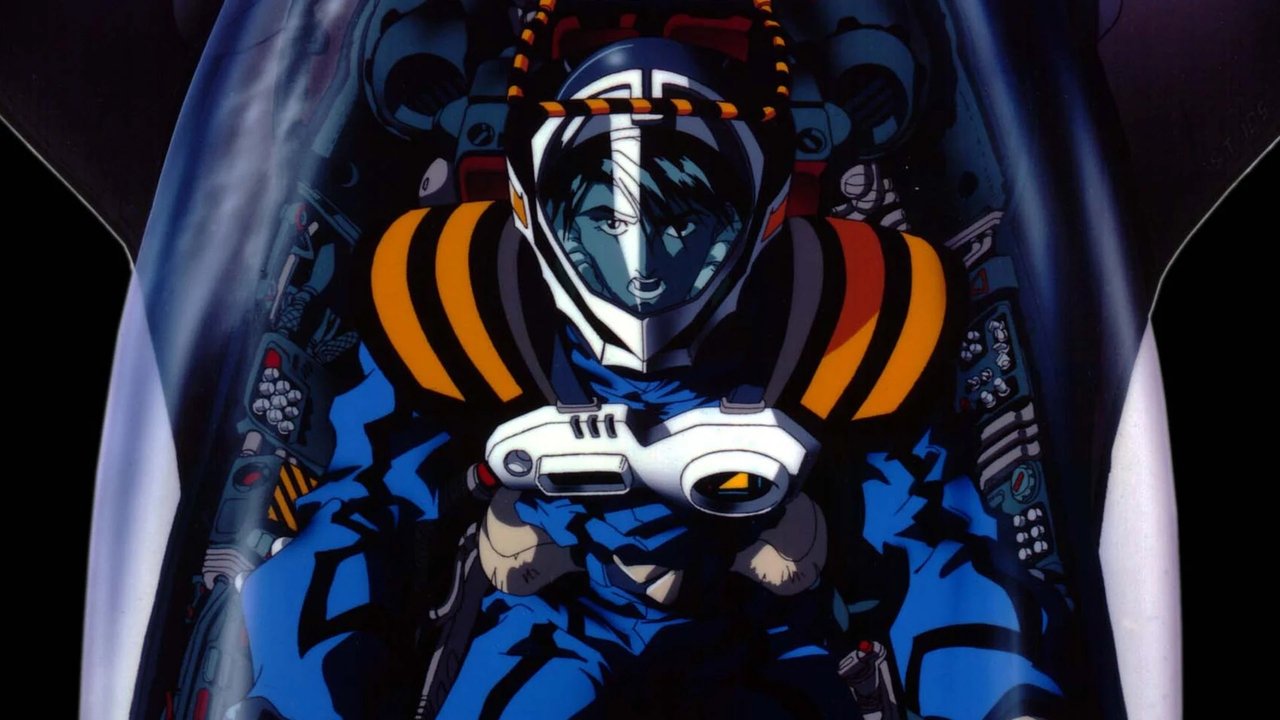
Macross Plus was planned as part of the "Four Great Macross Projects," which consisted of a live-action film, television anime, OVA, and theatrical film, but only the live-action film adaptation was never realized.
Due to director Shoji Kawamori's belief of "never doing the same thing twice," he was unable to get original concepts approved for ten years; however, when Bandai Visual's Minami Takanashi told him that the statute of limitations had passed, he simultaneously developed two conceptually contrasting projects, Macross 7 and Macross Plus, and when both were greenlit, parallel production became possible.
The creation of this work was motivated by backlash against the 1992 OVA Macross II: Lovers Again, which was produced without the involvement of Studio Nue; in particular, special effects director Ichiro Itano stated, "If there had been no II, I would not have done this work."
Director Shinichiro Watanabe made his directorial debut with this film. Since Watanabe aspired to direct live-action films and was inexperienced on set, he was cast as a support to the less experienced Kawamori, essentially positioning Kawamori as director and Watanabe as co-director.
Unshō Ishitsuka, who voiced Guld, was not cast through auditions but was directly appointed by Shoji Kawamori "purely for the coolness of his voice." After hearing Ishitsuka's performance, Watanabe Shinichiro's consciousness regarding voice acting changed.
To pursue realism in aerial combat depiction, the production team conducted research at Edwards Air Force Base and the Dryden Flight Research Center in America. Kawamori and Itano actually rode in NATO training aircraft at "Air Combat USA" and conducted mock dogfights, reflecting this experience in the animation. During this, Itano himself experienced G-forces and blacked out.
Itano Ichiro referenced radio communications from Japan Air Self-Defense Force test pilots and, believing that pilots cannot speak clearly during actual combat, had voice actors ride the Oji Yuuenchi roller coaster and recite their lines while experiencing G-forces.
Due to the intense work required for this production, Ichiro Itano suffered from shingles and overexerted himself, which became the catalyst for him to transition to CGI-focused work after recognizing the limits of hand-drawn animation.
In the theatrical film "MOVIE EDITION," the scene where the YF-21 evades all of Ghost X-9's missiles used 116 cel sheets in just 5 seconds, and due to its high quality, it is referred to as "the legendary 5 seconds."
Shoji Kawamori's introduction of CGI to anime began with this work. He was inspired after observing numerous staff members at the American production company Colossus performing finishing work using digital paint, and was shocked to discover that it could be done at low cost.
The brainwave waveform of Guld that appears in the first episode was created using the brainwave data of Yoshinori Sayama, who was in charge of CG, recorded on a Macintosh.
Composer Yōko Kanno handled the music for this work and for the first time single-handedly oversaw an anime soundtrack and composed an orchestral score for the first time. The music was recorded by the Israel Philharmonic Orchestra in Tel Aviv.
Kanno stated that she created Sharon Apple's songs "with the genuine intention of brainwashing listeners," and after receiving feedback such as "I joined the Air Force after hearing that song" and "I considered suicide listening to Sharon Apple's songs," she realized the frightening power of music's influence.
Director Shinichiro Watanabe, screenwriter Noriko Shimboto, and composer Yōko Kanno, who first met during the production of this work, later reunited for the television anime Cowboy Bebop.
The YF-21's design was modeled after the YF-23, which competed in the United States Air Force's next-generation fighter development plan (ATF), and the "Super Nova Plan" depicted in the film itself references this historical development competition.
The jacket of Aphex Twin's album "Selected Ambient Works 85-92," which had low recognition in Japan at the time, appears in the film. Paul Nicholson, who designed this logo, later designed the "Laughing Man" mark for Ghost in the Shell: Stand Alone Complex.