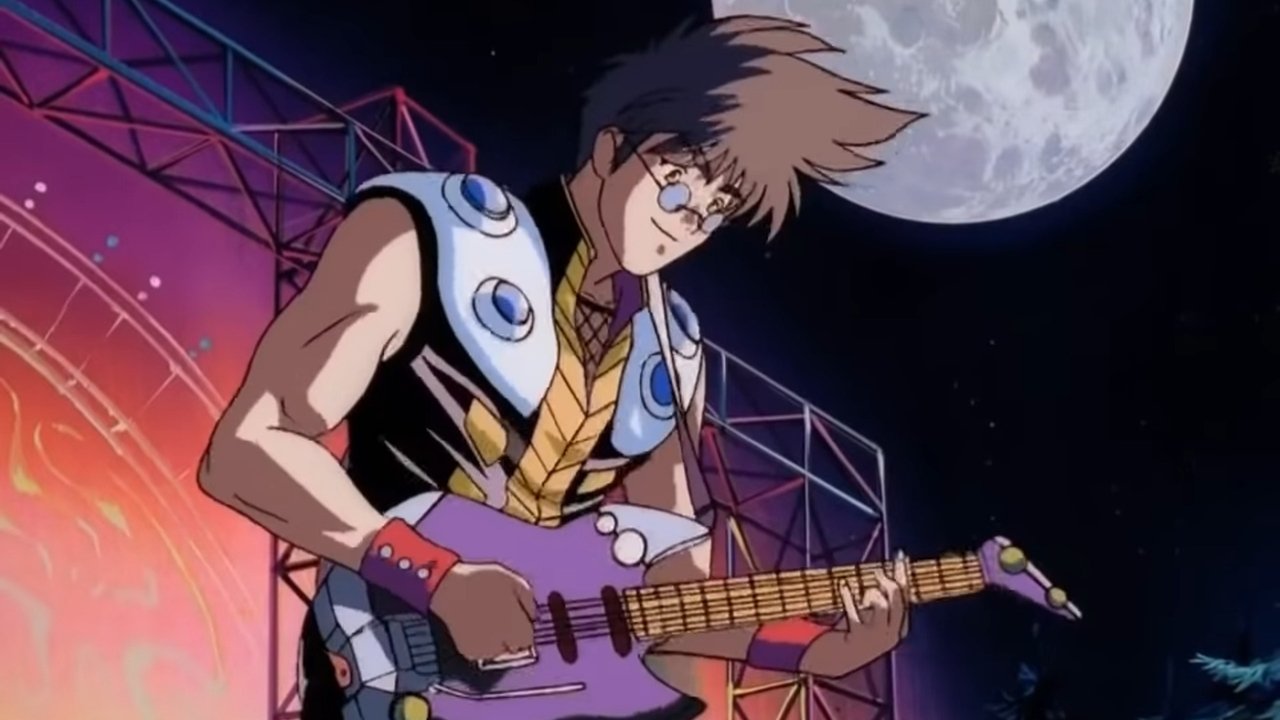
The project originated after an American company proposed a Hollywood live-action Macross movie; since the franchise had low recognition among children in Japan at the time, the studio decided to launch a new OVA and TV series simultaneously to boost popularity, also spurred by toy maker Bandai wanting a hit product to rival Gundam's plastic model line.
Series creator Shoji Kawamori had said for a decade after the 1984 film Do You Remember Love? that he would not touch Macross again, and only agreed to the new project on the condition that it would break from the established formula rather than simply continuing it.
Kawamori conceived the core idea of a 'singing pilot' who does not fight, an idea he feared might be rejected by sponsors, and this concept became the starting point from which the heroine and enemy designs were developed.
Kawamori has said the concept traces back to a lingering regret from Do You Remember Love?, where the alien leader Bodolza was ultimately defeated by gunfire rather than song, and he wondered if not firing a shot in the climax could have truly changed the era.
To avoid mental confusion between the two simultaneously produced projects, Kawamori deliberately split classic Macross elements between them, describing Macross Plus as a 'blue Macross' with a live-action-like, cold-flame feel, and Macross 7 as a 'red Macross' with a hot, comic-book-like, burning-flame feel.
Director Amino Tetsuro, chosen specifically to attract a new fanbase despite having no prior connection to the Macross franchise, had never watched the original 1982 TV series and deliberately avoided watching it during production to prevent its influence, relying instead on input from Kawamori and series composer Tomita.
Assistant director Yoshitaka Fujimoto volunteered for the project as a huge fan of the original Super Dimension Fortress Macross and served as a bridge between the veteran and new staff, remembering original setting details even some original staff had forgotten.
As a new approach for the franchise, normal character dialogue was voiced by seiyu while the singing parts were performed by professional musicians chosen first, with voice actors then cast to match the singers' voices; this division of labor was kept secret from the public until it was revealed at a live event called 'Let's Fire!!' on May 21, 1995.
No background score (BGM) is used anywhere in the series; all music heard is diegetic, originating from in-story singing, performances, or speakers, except for occasional cases where characters sing without instruments yet accompaniment is heard anyway.
The opening animation's dramatic single-take shot pulling back from Basara in City 7 to reveal all of Macross 7 combines hand-drawn animation with a 3DCG background, a technique deemed unlikely to work at the time since 3DCG was normally expected to be used on its own without mixing with 2D art.
Kawamori determined from earlier research on the OVA Macross Flash Back 2012 that a camera angle change of about 20 degrees would prevent viewers from noticing that the hand-drawn portions were flat, which made the hybrid 2D/3D opening shot possible.
A typical 30-minute TV anime episode at the time used about 2,000 to 3,000 animation cels, but the first episode of Macross 7 reportedly used around 7,000 cels.
That Basara Nekki piloted the main mecha, the Fire Valkyrie, was kept a strict secret before broadcast; the opening animation for episode 1 alone replaced the shot revealing him in the cockpit with a different cut, and the pre-broadcast special program did not reveal him as the protagonist, describing his fighter only as a 'mysterious machine with an unknown pilot'.
The Fire Bomber album 'LET'S FIRE!!' debuted at number 4 on the Oricon chart and sold over 300,000 copies, later winning the Animation category at the 1995 Japan Gold Disc Award, an unusually high commercial success for anime theme songs.
Despite the show's popularity, its unconventional take on a toyetic, non-fighting protagonist singing in battle provoked considerable backlash from fans of the original, more military-realistic Macross series.