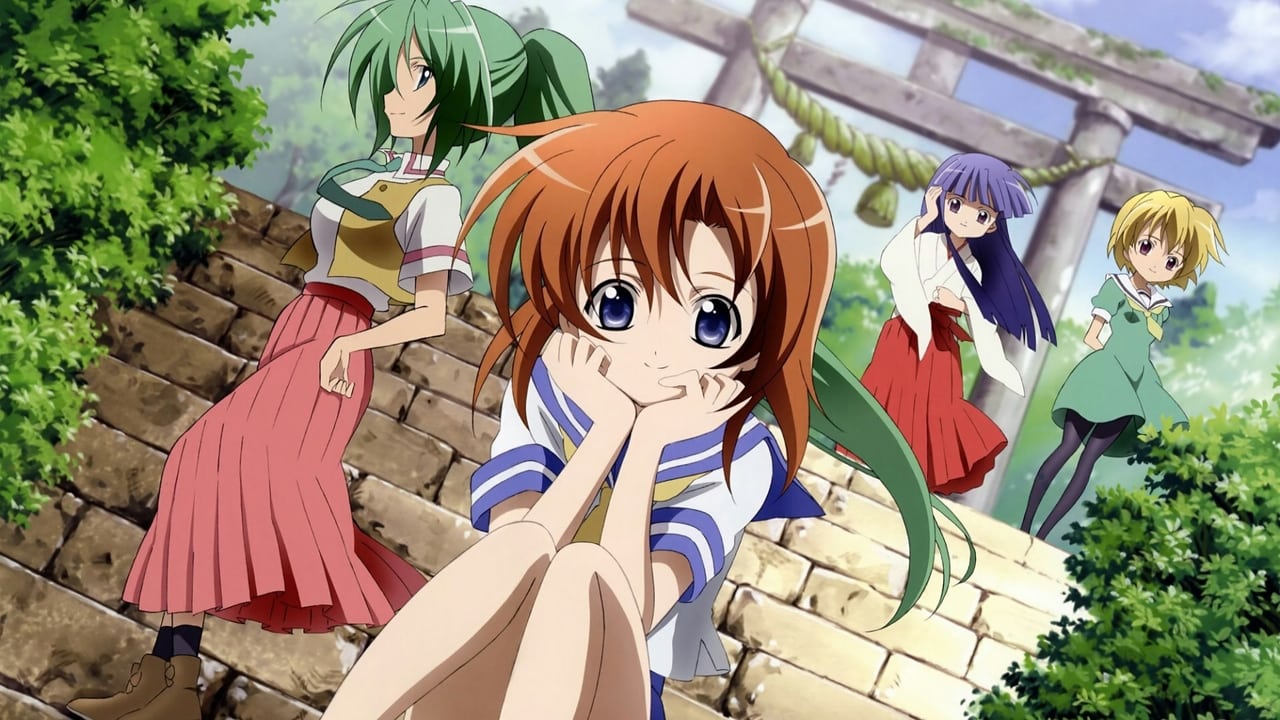
To design the anime scenes, director Ema Chiaki used location scouting photographs (rokihan) taken in the real village of Shirakawa-go and used them directly as the basis for composing the shots, with the aim of achieving a realistic quality closer to live-action filming.
Director Ema Chiaki stated that the scene of Teppei's head-splitting was one of the main reasons for his desire to participate in the project in the first place, and he had decided to draw it from the beginning without any consideration for the social atmosphere at the time.
To air the head-splitting scene on television, producer Urasakii Nobomiitsu limited its depiction to a shadow only, and used this argument (that it was merely a shadow) to convince the relevant authorities to approve its broadcast on television.
Initially, Mochizuki Tomomiitsu was supposed to write the overall screenplay, but he proposed removing elements from the original work to condense it for the anime duration, which prompted writer Ryukishi07 to reconsider his position as the original author, and later Kawashi Toshifumi joined as the screenplay editor after the chief of Studio Deen requested it via a direct phone call.
The final episode of the first season was originally supposed to conclude from an objective perspective through the character Akasaka from the 'Himatsuboshi' chapter, but based on Ryukishi07's wish, the ending was changed to end with Rika instead.
When selecting voice actors, Ryukishi07 was unfamiliar with the voice acting world, so he suggested names of actors who turned out to have mostly retired, gotten married, or were too busy, so he asked the relevant authority to provide a list of new candidate voice actors from scratch.
After hearing a voice sample from actor Hoshi Souchiro, Ryukishi07 strongly insisted on his selection for the role of Keiichi and expressed strong opposition to any alternative.
The suspension of the anime broadcast on several Japanese television stations in 2007 was caused by an apparent similarity between the work and a real murder committed by a 16-year-old girl against her father in Kyoto, despite a news program having provided an inaccurate description of the story based only on a portion of the 'Tsumihorouboshi' chapter.
After the broadcast suspension on some stations, the 'Kai' production committee issued an official statement denying any confirmed link between the real incident and the work, emphasizing that the work's message revolves entirely around the rejection of killing and violence.
In CD/DVD versions, all violent scenes that were modified or deleted during the television broadcast (such as darkening the screen or changing the blood color) were restored to their original uncensored versions.
In the 'Yakuzamashi' chapter of the second season, Takano's childhood memory was decided to be added in the final scene after extensive discussions, inspired by an additional episode called 'The Science of Children's Lunch' that could only be unlocked by completing the original game without any mistakes, and it was suggested by Ryukishi07 to carry the idea that 'children should be happy'.
For the 'Gou and Sotsu' project in 2020-2021, the idea was proposed that the work would initially appear as a remake of the original version and then gradually transform into an entirely new story, and the official title 'Gou' was kept hidden until the second episode aired to reinforce this impression with viewers.
To achieve the atmosphere of the 1980s, the scene of Satoko performing the 'Watanagashi' ritual in episode 16 of 'Gou' was inspired by the horror film 'The Evil Dead', while the battle scenes in episodes 14 and 15 of 'Sotsu' were inspired by the 1980s anime 'Gintama Taisen'.
To redesign the train station in the final episode of 'Sotsu', the old Nagoya Station was used as a model, in collaboration with the magazine 'Tabi to Tetsudou' to obtain accurate reference materials from that era.
The 'Gou' production team faced an unexpected challenge in recreating the 1980s era, as young animation team members noticed that the drawn beverage can ring pulls completely separate from the can (as they were at that time) looked to them like a drawing error, which surprised the older crew members.
The musician and Mongolian morin khuur player Ilana was asked to participate in composing the soundtrack for 'Gou and Sotsu' instead of the flute used previously, to give a different character to the main theme music.
In the scene where Rika's horns are broken and she transforms into a child, the original plan was to record the child's and adult's voices separately and then combine them, but voice actress Hidaka Noriko performed the voice transformation in the same session directly, which impressed director Kawaguchi Keiichiro.