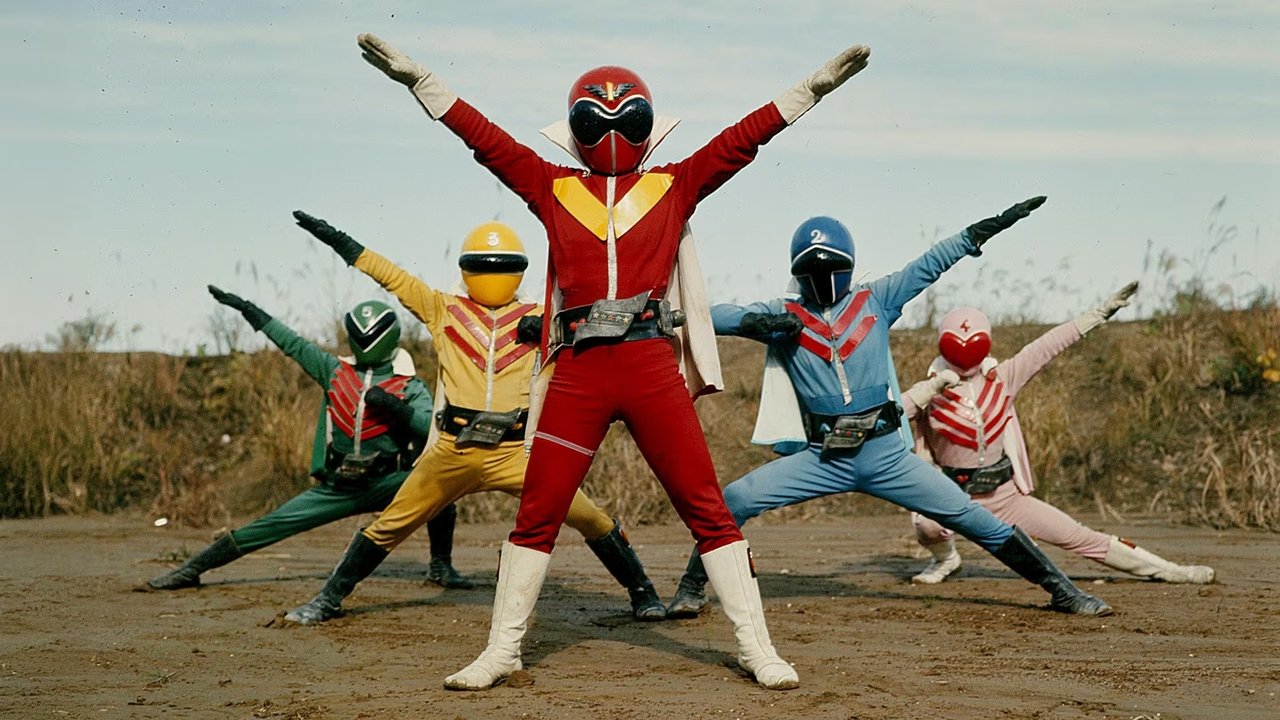
Himitsu Sentai Gorenger was created after NET (now TV Asahi) lost the broadcasting rights to the Kamen Rider series due to a network affiliation swap in 1975, prompting executive Ryotoku Watanabe to revive a shelved 'five heroes' concept inspired by Mission: Impossible that had previously been rejected by Mainichi Broadcasting.
The number of heroes was set at five because nine (as in Cyborg 009) was considered too many to depict in live action, three-hero teams were already being used in the concurrently developed Akumaizer 3, seven was too many, and four was considered unlucky in Japanese culture.
Creator Shotaro Ishinomori cited his own manga Shonen Dōmei as a visual inspiration for the concept of a team fighting together, and decided each ranger would be distinguished simply by color to reflect the color TV era, similar to the earlier show Kamen no Ninja Akakage.
The comedic tone of the show was proposed by art director Susumu Maezawa of Echo Productions, who suggested during a planning meeting that the drama and monsters be portrayed like a fun theatrical stage show rather than seriously.
Actor Yoshitaka Tamba, who would later play Goro Sakurai/Spade Ace in the follow-up series Jakker Dengekitai, was also considered for the role of Kaijo Tsuyoshi (Aka Ranger).
Hiroshi Miyauchi, already a established hero actor from Kamen Rider V3, was cast as Blue Ranger partly as insurance in case the red-suited leader wasn't accepted by audiences, since red was then strongly associated with 'a girl's color.' Miyauchi initially refused the role, and Ishinomori personally convinced him by comparing Aka Ranger to Miyamoto Musashi and Ao Ranger to Sasaki Kojiro.
Because Miyauchi was busy with his regular role in the drama Keiji-kun, the production accommodated his schedule by having his character often pilot the Varivrone separately, moving his opening credit position from second to last (only appearing after Aka, Ki, Momo, and Mido), and allowing some early episodes to feature only his voice for the transformed character.
Kenji Asuka (Mido Ranger) was originally cast as new singer Akihiko Kishi, but he departed right after production began, and Yukio Ito took over as a last-minute replacement; director Koichi Takemoto recalled that this caused the shooting of episode 1 to take twice as long as normal.
Actor Baku Hatakeyama, who played Daita Oiwa (Ki Ranger), was cast thanks to his connection with manga artist Mitsuru Sugaya, a friend and disciple of Ishinomori.
During the first promotional photo shoot in January 1975, the original long capes designed by Ishinomori caught fire during a demonstration of the Birdy rocket-boosters, prompting an immediate switch to the shorter capes seen in the actual series.
Eri Kanuma, who played liaison agent 007/Yoko Kato, injured her back after falling from a height while being chased by a Zolder extra at an amusement park (Koyama Yuenchi), and had to record her remaining dialogue lying down; she did not appear in the final episode.
Actor Baku Hatakeyama was temporarily replaced by Daruma Jiro as the second Ki Ranger (Daigoro Kumano) for several episodes because Hatakeyama was cast in a regular role in another Nippon TV drama after being personally selected by actor Hiroki Matsukata.
Naoya Makoto, who played Kaijo Tsuyoshi (Aka Ranger), stated that his motorcycle scenes were performed without stunt doubles.
The theme song single 'Susume! Gorenger / Himitsu Sentai Gorenger' sold over a million copies, becoming a major hit that helped drive the show's popularity.
The series achieved a peak viewership rating of 22% and ran for a record 84 episodes over two years, a broadcast length that remains unmatched by any other entry in the Super Sentai franchise.
The character name Peggy Matsuyama was a pun combining the name of singer Peggy Hayama with the city of Matsuyama in Ehime Prefecture, itself a playful reference to Hayama's famous song about neighboring Kochi Prefecture.
The five original Rangers' surnames (Kaijo, Shinmei, Oiwa, Peggy, Asuka) form an acrostic spelling 'Cassiopeia,' which becomes an important plot point building toward the series finale.