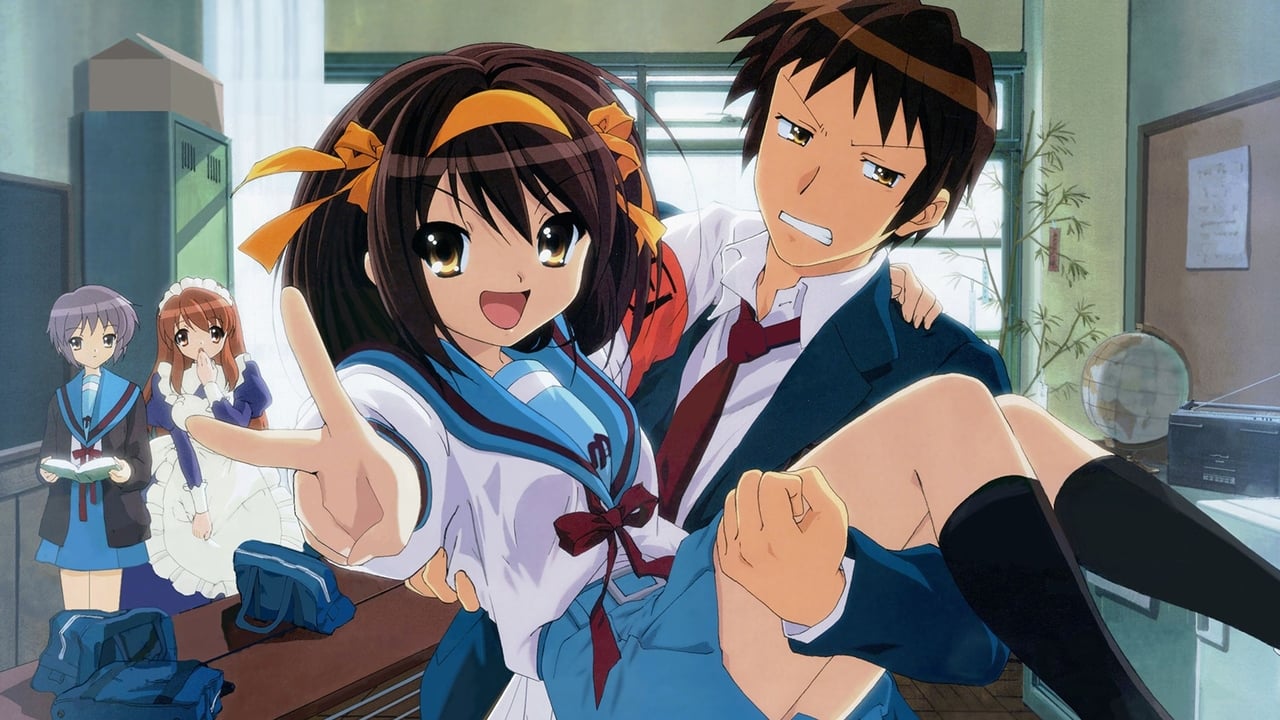
According to Kadokawa Sneaker Bunko editor-in-chief Takehiko Nozaki, the Haruhi Suzumiya series began less as a novel project and more from 'devising illustrations' and choosing illustrator Ito Noizi, with marketing centered on her art planned even before the manuscript was read.
Director Yasuhiro Ishihara felt the novel's appeal came from the pleasure of reading prose and worried it might not be suited to animation, a doubt shared by original author Nagaru Tanigawa himself about whether the story could work as anime.
The show's structural planning meetings were held at Lake Biwa, where director Ishihara, series director Yamamoto, author Tanigawa, composer Satoru Kousaki and art director Seiki Tamura read through the novels overnight to unify their understanding of the character Haruhi before production began.
The famous non-chronological 'shuffled broadcast' order of the first season originated when Tanigawa casually suggested during a staff meeting that the episodes did not need to be aired in chronological order, a decision made to give surprises to readers already familiar with the books.
Series director Yamamoto decided the first broadcast episode should be 'The Adventures of Mikuru Asahina Episode 00', reasoning that if Haruhi were the true 'super director' of the show, she would naturally choose to open with a chaotic amateur film of her own making; the opening credits even display 'Super Director: Haruhi Suzumiya' in a larger font than the actual director's name.
For the amateur-film episode, staff deliberately made the animation look like poorly-shot live-action footage, requiring extra work to recreate 'filming mistakes,' and director Ishihara said the hardest part was instructing the voice actors to intentionally act badly.
Screenwriter Shoji Gatoh (known for writing Full Metal Panic!) was chosen by Tanigawa himself during a planning meeting to write the episode 'Sagittarius no Hi,' his first time writing for someone else's original work, and he struggled with strict character-count limits for the dialogue.
The original anime episode 'Someday in the Rain,' written by Tanigawa himself, deliberately broke the series' rule that 'no drama happens where Kyon isn't watching' by using a third-person 'fixed-point observation' concept, an idea Yamamoto proposed to Tanigawa half-jokingly.
In that same episode, Nagato is shown silently reading for over three minutes of continuous shot, filmed as if from three hidden cameras hinted to be planted by the Computer Society president; Nagato speaks no lines in the episode and voice actress Minori Chihara is not even credited for it.
For the 'Live Alive' concert episode, animators used rotoscoping to accurately depict guitar and bass finger movements and drum hits because none of the animators had experience playing instruments; Haruhi's singing facial expressions were also drawn based on footage of voice actress Aya Hirano's face recorded during the actual song recording.
The 'Live Alive' episode required roughly twice the number of drawn frames as a normal episode since the staff wanted every background character at the school festival to be animated and moving, pushing the production team to its limits.
Composer Satoru Kousaki, working on his first-ever TV anime score, took inspiration from Shiro Sagisu's style for the confrontation scene between Nagato and Asakura, aiming for a sound reminiscent of Nadia: The Secret of Blue Water and Neon Genesis Evangelion.
For 'Endless Eight,' Kousaki composed music intended to be different for all eight nearly-identical episodes, effectively writing the equivalent of eight episodes' worth of score even though not all of it ended up being used.
For the insert songs performed in-universe by the band in 'Live Alive,' music producer Shigeru Saito hired professional musicians (guitarist Susumu Nishikawa, drummer Yutaka Odawara, bassist Ken Taneda), instructing the guitarist to play with 'inhumanly' advanced technique to reflect Nagato's alien nature while the other two played like ordinary high schoolers.
Voice actress Aya Hirano invented the original, non-canon character 'Nekoman' by doodling it on her lyric sheet during the recording of the opening theme; director Ishihara later asked to use the drawing for a needed 'cute mascot' character, and it ended up appearing far more often than he expected, including on the official website.
Voice actress Minori Chihara watched Terminator 2 to help build her image of the emotionless, powerful android character Yuki Nagato.
To voice the 'Mikuru Densetsu' insert song badly on purpose, Yui Horie...