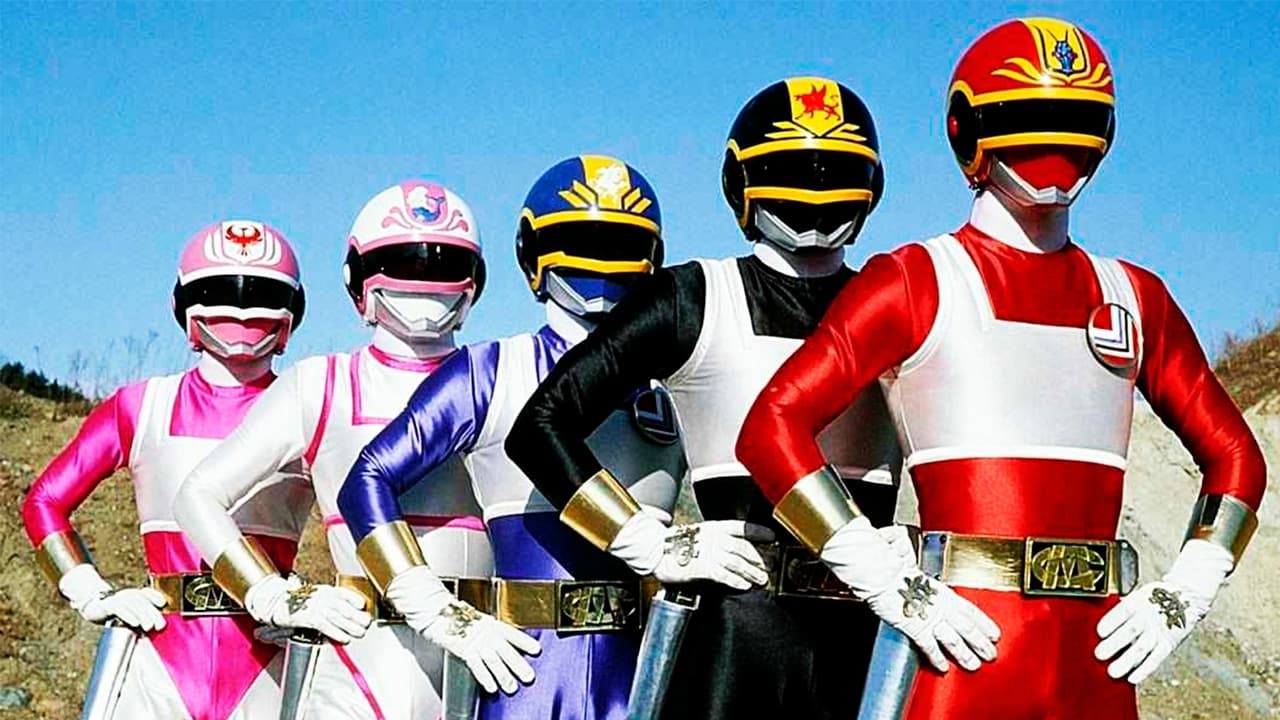
The series was designed to differentiate itself from its predecessor Choudenshi Bioman by emphasizing a military, Self-Defense Forces-inspired tone and youthful, sweaty heroism, while returning to classic Super Sentai patterns like roll-call poses and enlarging monsters.
The villain organization Gozma was deliberately designed as a non-monolithic alliance of alien races forced into invasion by circumstance, with a biological rather than mechanical visual theme, contrasting with the robotic New Empire Gear from the previous series.
The project's working title during planning was 'Cosmoman', though the final concept remained largely unchanged from early development.
The villains were scaled up to a galaxy-spanning empire partly because the Space Sheriff series had just ended, freeing up that narrative niche.
Casting for the lead role of Hiryu Tsurugi/Change Dragon was difficult, and if no suitable actor had been found, Junichi Haruta (who had twice played Black Ranger types before) was considered as a backup, which delayed the shooting start to late November 1984.
Actor Haruki Hamada, who played Hiryu, passed the audition after just a single interview.
Hiroko Nishimoto (Sayaka) was cast largely because of a strong solo acting performance she gave during her audition.
Kana Fujieda, who played Adjutant Seama, was primarily a model with no acting experience, so a man's voice was dubbed over her lines early on to help establish the character's tough persona.
Actress Fukumi Kuroda, who played Queen Ahames, had no prior background in tokusatsu and had been struggling with stereotypical young-woman roles in period dramas before accepting producer Takeyuki Suzuki's offer.
Booba's actor Yoshinori Okamoto was seriously injured in a traffic accident right after finishing filming his character's final episode (52), completed his dubbing work afterward, and then took six months off to recover.
Episodes 17 and 18, introducing Queen Ahames, involved a large-scale location shoot in Nagasaki at the then-under-construction Nagasaki Holland Village theme park.
Episode 53, 'Ahames in Flames', which depicted Ahames' death, achieved the show's highest ever rating of 16.1%.
During the first episode's shoot, the Hydler soldiers were introduced covered in large amounts of slime, which frightened child audiences so much that children visiting subsequent location shoots would run away in fear whenever Hydler troops appeared.
The red jacket worn by Hiryu from episode 13 onward was brought in by actor Haruki Hamada himself, who proposed the costume change because he felt 'the main hero should wear red'.
Change Dragon's on-screen dominant hand differs from his civilian form because actor Haruki Hamada is left-handed while his suit actor Kazuo Niibori is right-handed.
The photoshoot costume intended for actress Mai Ooishi (Mai Tsubasa) was based on an outfit singer Yu Hayami wore on a TV program, though it ultimately went unused in the actual broadcast; the Hawaiian shirt Mai's character wore in summer episodes was made by the actress's own mother.
For episode 1, the helicopter used was included at the specific request of director Nagafumi Hori, according to Toei producer Takeyuki Suzuki.
The design for Adjutant Booba's helmet was originally meant to be a bald head covered in gold ornamentation, but was redesigned into a helmet shape because actor Shohei Yamamoto could not wear the intended piece, and the face was changed to gold at Yamamoto's own suggestion.
The Gyodai creature suit reused the same hand-held staff mechanism structure as the Kumokansu suit from Choudenshi Bioman.
Booba's design was inspired by Klingons from Star Trek combined with the image of a defeated samurai (ochimusha), and after the film Predator was released in 1987, fans noted a resemblance between Booba and the Predator alien.
Queen Ahames' visual design drew on traditional Japanese aesthetics such as Noh and Kabuki theater via input from puppet designer Jusaburo Tsujimura, and her intended hairstyle was meant to evoke the Kabuki dance 'Renjishi', though this was not realized due to the unavailability of a new wig.
All songs performed for this series by singer Hironobu Kageyama were credited under the pseudonym 'KAGE' rather than his own name, a decision made because his record label worried a children's tokusatsu association might hurt his prospects as a rock singer; he later used his real name starting with the next series, Choushinsei Flashman.
Kageyama recorded the series' songs during a career low point, earning only about 70,000 yen a year as a singer after his band Lazy disbanded, working construction jobs while performing in small live houses when the offer for this series came.
The opening theme was the first in Super Sentai history to use a shuffle beat, a choice pushed by producer Takeyuki Suzuki who insisted on a four-beat rhythm despite some internal opposition.
Mixed martial artist Rodrigo Gracie, known for competing in PRIDE, used the show's opening theme as his entrance music.
Toy sales for this series set a new commercial record for the Super Sentai franchise, surpassing even the previous record set by Choudenshi Bioman, at a time when the Famicom boom was otherwise depressing the boys' character toy market.
At 55 episodes, this remains the second-longest Super Sentai series after Himitsu Sentai Gorenger, a length that resulted from a scheduling adjustment: the following year's Metal Hero series was shifting to an April start, so this show's run was extended to keep Choushinsei Flashman's start aligned to March.