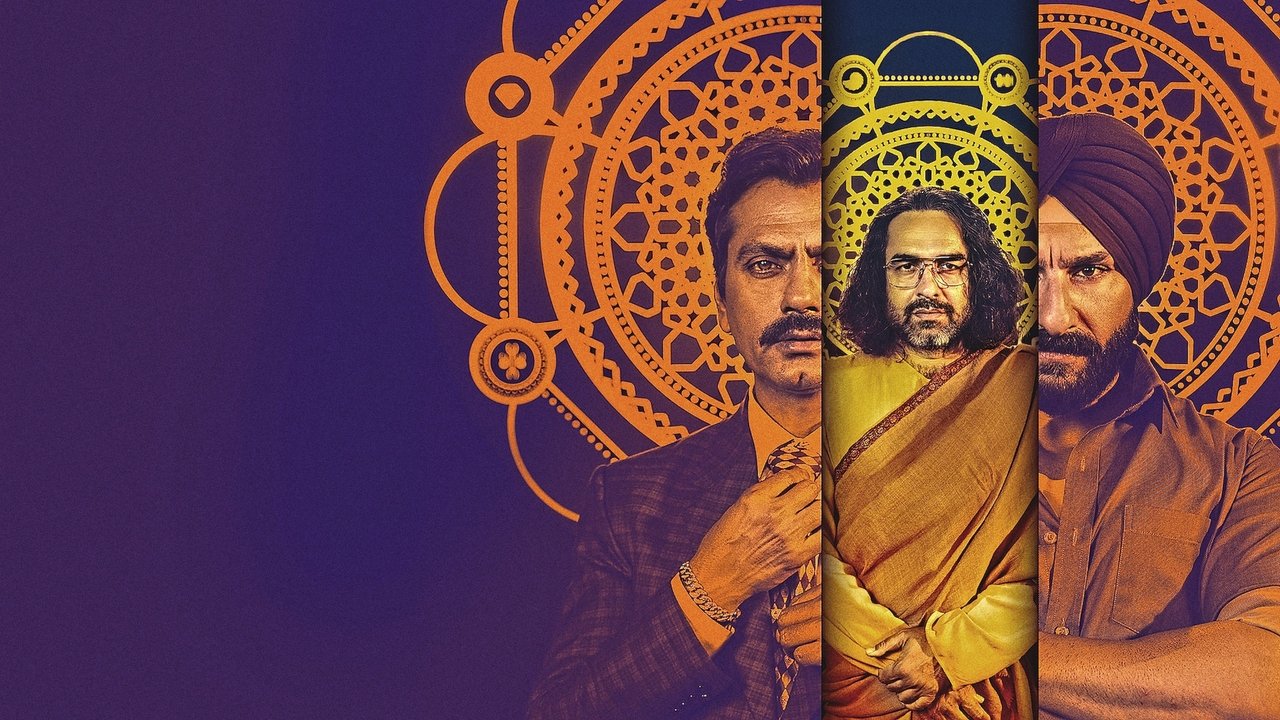
Netflix vice-president Erik Barmack discovered Vikram Chandra's 2006 crime novel Sacred Games while searching for Indian content that could appeal to a global audience, calling it 'an interesting property'.
Director Vikramaditya Motwane had already read Chandra's earlier novel Love and Longing in Bombay, which introduced the character Sartaj Singh, before meeting Netflix's team in Los Angeles in 2014.
Anurag Kashyap had previously been approached in 2014 by AMC and Scott Free Productions to direct an English-language adaptation of the novel, but declined because he didn't want to do 'anything based in India in English'.
Motwane originally wanted a different director for each episode but abandoned the idea due to scheduling conflicts, instead suggesting he and Kashyap co-direct since the story's two parallel tracks needed two distinct voices.
Author Vikram Chandra reviewed the scripts and served as a script consultant; the writers said he was so research-intensive that they didn't need to consult any other researcher.
All episode titles in season one are drawn from Hindu mythology, such as 'Aswatthama' (a character cursed with immortality after the Kurukshetra War) and 'Rudra' (the angry form of Shiva), each thematically tied to the episode's events.
The show's title sequence and logo, designed by Aniruddh Mehta and the Mumbai studio Plexus, blend imagery from ancient Hindu scriptures, mandalas and Indus Valley Civilization characters, and the sequence also includes real footage of events like the demolition of the Babri Masjid.
The character Kukoo, only briefly mentioned as a dancer in the novel, was significantly expanded in the series into Gaitonde's prominent love interest, while the minor character Malcolm Murad became a major assassin figure.
Saif Ali Khan read parts of the novel but stopped because it wasn't helping him find what he needed as an actor for Sartaj Singh.
Sartaj Singh's physical appearance was deliberately changed from tall and thin in the novel to muscular and heavier in the series to make the character more 'visually engaging'.
Motwane said Nawazuddin Siddiqui was his first choice for Ganesh Gaitonde because he 'plays gangster so well' and has the aura required for the role.
Kubbra Sait was asked to audition for the transgender character Kukoo by Anurag Kashyap at a screening of Mukkabaaz at the MAMI Film Festival, and wore a prosthetic penis for the role.
Girish Kulkarni was originally offered the role of Constable Katekar but declined it because he wanted a character who would appear in both Sartaj's and Gaitonde's storylines, and was cast instead as minister Bipin Bhosale.
Surveen Chawla filmed her season two scenes while pregnant.
Motwane and Kashyap filmed their portions separately, with Motwane directing present-day scenes with Saif Ali Khan and Kashyap filming 1980s Bombay scenes with Nawazuddin Siddiqui, an approach Kashyap called 'painfully difficult' due to the challenge of finding parts of Bombay that still looked period-appropriate.
A scene featuring Kubbra Sait involving frontal nudity was filmed in seven takes.
The shootout at Gaitonde's house was filmed across three locations using long takes on Steadicam and hand-held cameras.
Season two was shot on a 50-day schedule, extensively filmed in Mombasa, Cape Town, Johannesburg and Nairobi, with Siddiqui filming his scenes in Nairobi and Khan filming his in Mumbai.
Cinematographer Swapnil Sonawane used 'worn-out but very warm lenses' for Sartaj Singh's scenes to reflect how nothing is working out in his life, while the color yellow was used in Gaitonde's scenes to signify the guru he begins to follow.
Composer Alokananda Dasgupta created the ominous opening theme by humming gibberish lines with a vocalist and recording them with a cello, intending it to have a religious connotation without evoking any specific religion.
For the tracks 'Dance Capital' and 'Labon Se Chhukar,' composer Rachita Arora was told by Kashyap to listen to Bappi Lahiri's songs to capture the 'infectious rhythm' that defined his music.
Season one is the only Indian series to appear on The New York Times' list of 'The 30 Best International TV Shows of the Decade'.
On Rotten Tomatoes, season one holds a 92% approval rating from 26 critics, while season two dropped to 60% from 5 critics, reflecting a more mixed reception for the second season.
In 2018, a Congress party member filed a police complaint against Netflix and Nawazuddin Siddiqui for allegedly insulting former Prime Minister Rajiv Gandhi in one scene; the complaint was withdrawn after Rahul Gandhi tweeted that fictional characters' views couldn't change his father's legacy, though Netflix refused to alter the English subtitle in question.